Offshore Wind Financing Gap
Offshore Wind Power Faces Growing Investment Gap Despite Rising Global Demand
Anonymous
Key Points
1
The global wind-energy market is projected to reach approximately $287.9 billion by 2035, according to a market outlook cited by Simply Wall St.
2
Hanwha Solutions plans separate memorandums of understanding with Chinese cable manufacturers ZTT and Hengtong. With ZTT, it will develop 132-kilovolt wet-type offshore-wind cable materials and provide technical support, while Hengtong will collaborate on materials for extra-high-voltage, submarine and HVDC transmission cables.
3
The TGS | 4C report forecasts that more than 12 GW of offshore wind capacity will enter operation in 2026, while only 5.6 GW is expected to reach final investment decision by year-end—making 2026 the second-lowest year for investment decisions since 2020.
4
TGS | 4C estimates that a one-percentage-point increase in the cost of capital raises an offshore wind project’s levelized cost of electricity by roughly 9% to 11%; the report also says steel prices are 53% higher year over year.
5
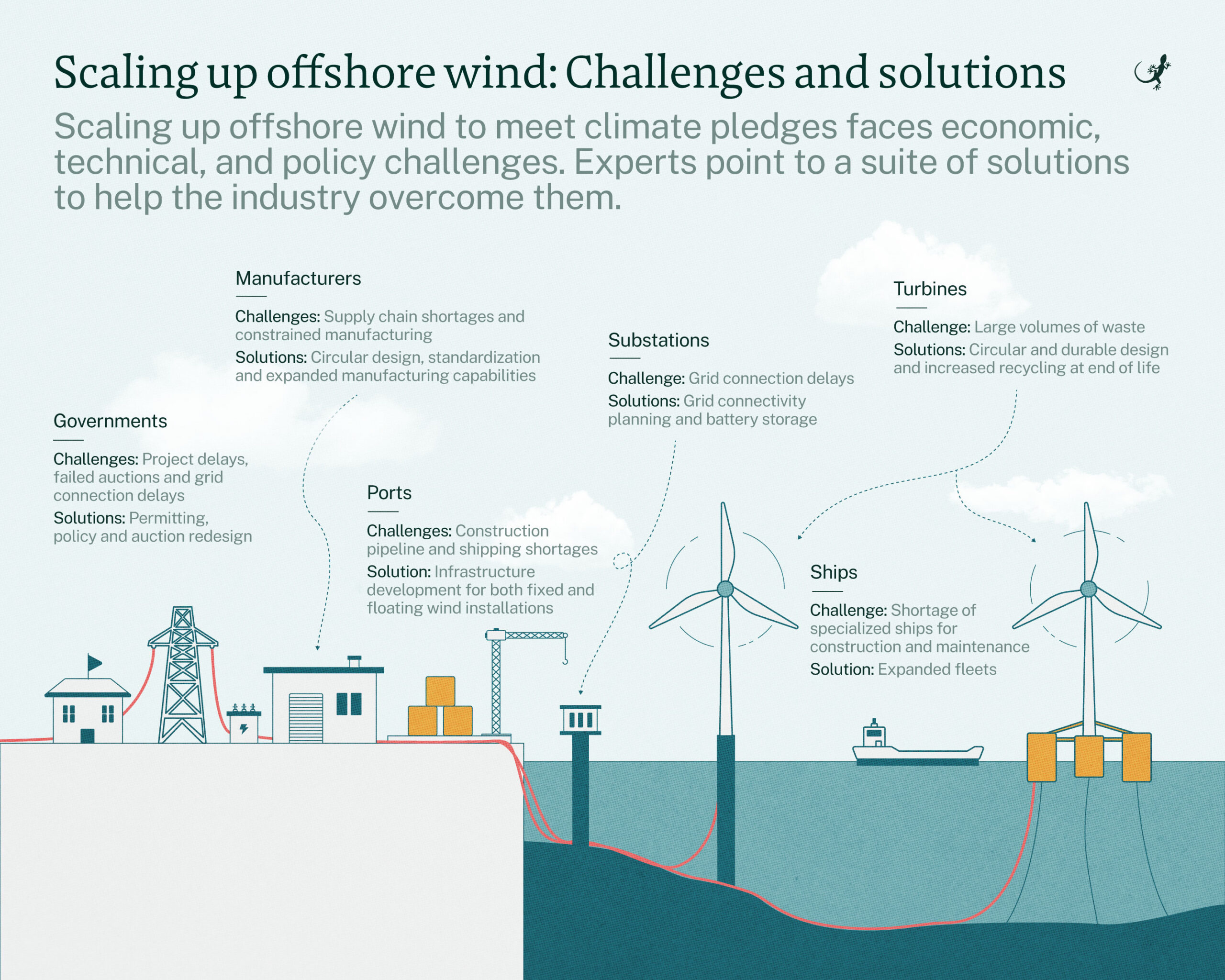
Modern wind-turbine installation vessels can exceed 2,500 tonnes in crane capacity and provide hook heights above 150 meters, compared with earlier jack-up barges that generally handled turbines in the 3-to-6-MW range and were limited to shallower waters and narrower weather windows.
Offshore wind is booming globally, with 92.7 gigawatts already operating. But the industry faces a financing crunch: only 2.1 GW reached final investment decision in 2026, while 22.2 GW awaits approval. Simply Wall St projects the wind market will hit $287.9 billion by 2035, but rising interest rates, steel prices 53% higher year-over-year, and geopolitical tensions are stalling new projects. TGS | 4C forecasts 2026 will be the second-lowest year for investment decisions since 2020, even as 12 GW of new capacity comes online—exposing a widening gap between development and construction financing.
Equipment makers and cable suppliers are racing to fill the gap. Modern installation vessels now exceed 2,500 tonnes in crane capacity, enabling turbines of 14 to 18 megawatts in deeper, harsher waters. Market Screener reports Sumitomo Heavy Industries partnered with Albatross Technology to accelerate floating offshore wind deployment in Japan. Hanwha Solutions is also pursuing Chinese partnerships to develop specialized cable materials and recycling technology for submarine and high-voltage transmission lines.
A Capital Crisis Blocks Construction Starts
Offshore wind faces a financing squeeze. TGS | 4C estimates that a one-percentage-point increase in borrowing costs raises a project's electricity price by 9% to 11%. Steel prices are 53% higher than last year. Only 5.6 GW is projected to reach final investment decision by year-end 2026, versus 12 GW entering operation. That gap signals developers cannot secure funding fast enough to match pipeline growth.
Vessels Transform What Turbines Can Build
Next-generation installation ships are game-changers. Modern crane vessels exceed 2,500 tonnes lifting capacity and reach heights above 150 meters. Older jack-up barges handled 3-to-6-MW turbines in shallow water only. Today's giants support 14-to-18-MW turbines in deep, rough seas. This hardware leap unlocks offshore sites previously out of reach—but only if projects get financed.
Supply Chain Bets on China Partnerships
Market Screener reports Sumitomo Heavy Industries and Albatross Technology formed a capital partnership to deploy floating offshore wind in Japan, advancing energy security and decarbonization. Hanwha Solutions is pursuing similar expansion in China, signing memorandums with ZTT and Hengtong to develop specialty cables for offshore wind, submarine systems, and high-voltage transmission. These partnerships aim to reduce rare-earth supply risks and boost manufacturing capacity before financing barriers ease.
U.S. Maritime Jobs Face Cancellation Threat
Heavy Lift & Project Forwarding International warns that offshore wind cancellations are damaging America's maritime supply chain. Ports, vessel operators, and equipment makers invested billions to serve a growing project pipeline. Now cancellations threaten those shipyard jobs and infrastructure investments. The U.S. market slowdown contrasts sharply with global growth expectations, leaving workers and suppliers caught between long-term industry optimism and near-term funding collapse.
Sentiment
Mostly PositiveNEGATIVENEUTRALPOSITIVE
Publishers
13
Articles
14
Reach
27
A
AnonymousAuthor


