Retos Climáticos en España
España destaca en adaptación climática mundial pero enfrenta importantes retos en agua y energía
Anonymous
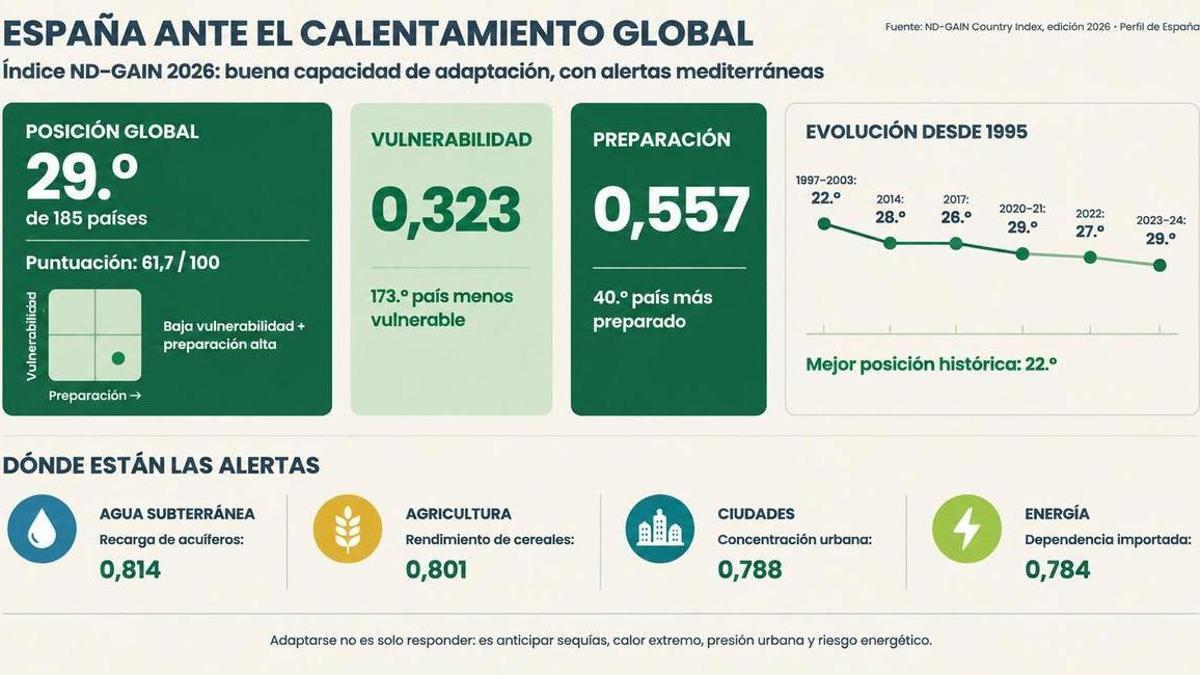
Spain ranks 29th globally in climate adaptation readiness, according to the ND-GAIN index, placing it well ahead of most nations in preparing for global warming impacts. La Opinión de Murcia reports that Spain shows stronger resilience than vulnerability when facing climate risks, but three critical areas demand urgent attention: water scarcity, agricultural stress, and energy security.
Spain's relatively strong position masks underlying pressure points. Water resources face mounting strain from drought and rising temperatures. Crops face damage from unpredictable weather. Energy dependence remains a structural weakness as the country transitions away from fossil fuels. These three sectors define the real challenge ahead.
Spain's Climate Resilience Outpaces Vulnerability
The ND-GAIN (Notre Dame Global Adaptation Initiative) index ranks 192 nations on their capacity to adapt to climate impacts. El Día notes that Spain's 29th-place position reflects solid infrastructure, economic resources, and governance systems that help absorb climate shocks. Most developing nations fall far behind this benchmark, making Spain's standing a relative strength in the European context.
This ranking reflects decades of investment in climate monitoring and disaster response systems. Spain has built emergency protocols for heat waves and floods. The country maintains research institutions tracking climate trends. Economic stability provides resources for adaptation projects. However, the index score hides serious vulnerabilities in specific sectors that could unravel if unchecked.
Water Scarcity Threatens Farms and Cities
Spain's water systems face unprecedented pressure. El Periódico Mediterráneo reports that drought cycles are intensifying across the Iberian Peninsula, draining reservoirs that feed agriculture and urban centers. Climate models project further reductions in annual rainfall, particularly in the south and east where irrigation demands are highest.
Groundwater depletion accelerates the crisis. Farmers rely on aquifers that refill too slowly to match extraction rates. Municipalities compete with agriculture for limited supplies during dry seasons. La Opinión de La Coruña highlights that water stress will force difficult choices between crop production and drinking water security over the next decade.
Agriculture Faces Rising Heat and Erratic Weather
Spain's farming sector produces major crops: wheat, olives, grapes, and vegetables. El Correo Gallego reports that climate instability is damaging yields through heat stress, late frosts, and irregular rainfall patterns. Olive groves in central regions are showing signs of stress from prolonged heat. Vineyards face threats to grape quality as temperatures climb.
Pests and diseases flourish in warmer conditions, creating new agricultural headaches. La Opinión de Zamora notes that farmers must adapt crops and practices rapidly or watch productivity collapse. Irrigation expansion runs up against water scarcity, trapping farmers between conflicting pressures. Investment in drought-resistant varieties and precision farming becomes essential for survival.
Energy Independence Remains Spain's Structural Gap
Spain relies on imported fossil fuels for roughly 75% of primary energy needs. Diario de Mallorca explains that while renewable capacity has grown sharply, the country still depends on gas imports from unstable suppliers and volatile global oil markets. Transitioning to clean energy takes time and capital. Until then, energy security remains hostage to external shocks.
Renewable expansion offers hope but faces bottlenecks. Diario de Ibiza reports that solar and wind farms are multiplying, yet grid infrastructure lags behind generation capacity. Battery storage remains expensive and limited. The energy transition is underway but will not reach completion for years, leaving Spain vulnerable to price spikes and supply disruptions during the interim period.
Sentiment
NeutralNEGATIVENEUTRALPOSITIVE
Publishers
14
Articles
0
Reach
14
Topics
A
AnonymousAuthor


