Betelgeuse's Companion Found
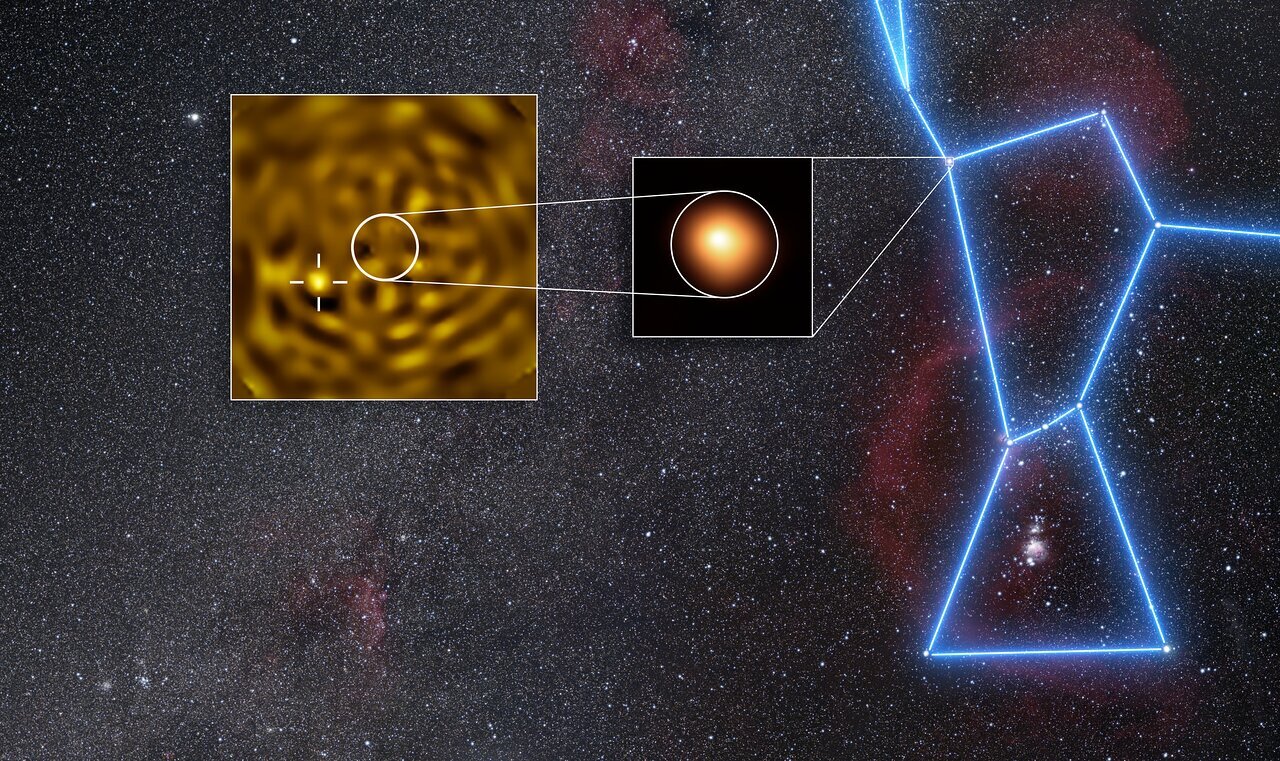
Clearest Images Confirm Betelgeuse Companion Siwarha, Explaining Star's Variability
Anonymous
Key Points
1
The faint companion has been named Siwarha, meaning 'her bracelet,' a nod to Betelgeuse’s Arabic name meaning 'hand of the giant.'
2
Researchers achieved the detection using SPHERE-ZIMPOL, a high-contrast imaging mode on the VLT, which isolates the faint Betelgeuse B light from the glare of Betelgeuse A.
3
Predictions published in 2024 suggested Betelgeuse B would be at its farthest separation from Betelgeuse A in December 2024, which helped guide the observing campaign to maximize chances of detection.
4
Montargès recalled the moment of discovery with, 'I jumped from my chair when I saw the processed images,' and the team also notes that Betelgeuse B is more massive than predicted, aiding its visibility.
Astronomers have captured the clearest image yet of a companion star orbiting Betelgeuse, ending a century-long search and confirming that the famous red supergiant is part of a binary system Phys.org. The companion, named Siwarha, was spotted in December 2024 using a powerful instrument on the European Southern Observatory's Very Large Telescope in Chile.
Siwarha — meaning 'her bracelet' in Arabic — weighs roughly 2.6 to 3.1 times the mass of the Sun Science News. Scientists say the find helps explain decades of puzzling brightness changes in Betelgeuse, one of the brightest stars in the night sky.
A Century of Clues Finally Points to Siwarha
For over 100 years, astronomers noticed that Betelgeuse's brightness did not behave normally. It dimmed and brightened on a roughly six-year cycle that hinted at something hidden nearby Mirage News. No telescope could pick it out — until now.
Researchers published predictions in 2024 saying Siwarha would reach its farthest point from Betelgeuse in December of that year Phys.org. That wide separation made detection easier. The team planned its observations around that window to maximize their chances.
SPHERE Instrument Pulls Siwarha Out of the Glare
The discovery used SPHERE-ZIMPOL, a high-contrast imaging mode on the VLT Science News. This tool was built to find planets around other stars. It works by blocking the blinding light of a bright star so fainter objects nearby can be seen.
Betelgeuse outshines its companion by an enormous margin, making Siwarha very hard to see. But the companion turned out to be more massive than earlier models predicted Yahoo News. That extra mass made it slightly brighter and easier to detect than expected.
'I Jumped From My Chair' — The Moment of Discovery
Lead researcher Miguel Montargès described seeing the processed images for the first time. 'I jumped from my chair when I saw the processed images,' he said Head Topics. The team spent weeks carefully separating Siwarha's faint light from the glow of Betelgeuse itself.
The name Siwarha was chosen to honor Betelgeuse's Arabic roots Phys.org. Betelgeuse comes from an Arabic phrase meaning 'hand of the giant.' Siwarha, or 'her bracelet,' wraps that same cultural thread around the newly found companion.
Follow-Up Observations Planned Through 2027
The detection is called the strongest evidence yet — not an absolute final proof Mirage News. Scientists are planning more observations to nail down Siwarha's orbit and confirm its mass. Follow-up work is expected to continue into late 2027.
If confirmed fully, the binary model would explain Betelgeuse's long six-year brightness cycle as a gravitational effect from Siwarha Science News. It would also change how astronomers think about the star's future supernova explosion, which could happen within the next 100,000 years.
Sentiment
Mostly PositiveNEGATIVENEUTRALPOSITIVE
Publishers
17
Articles
8
Reach
25
Topics
A
AnonymousAuthor


