OIC Kashmir Talks
OIC Ministers Reaffirm Support for Kashmiri Self-Determination at UN General Assembly
Anonymous
Key Points
1
OIC Secretary-General Ismail Ould Cheikh Ahmed described self-determination as the “inalienable” right of the Kashmiri people and the basis for a “just and lasting” peace in South Asia.
2
Pakistan’s Foreign Minister Ishaq Dar said Jammu and Kashmir remains an internationally recognized dispute under active consideration by the U.N. Security Council, while accusing India of attempting to alter the territory’s demographic, political and cultural character.
3
Shamim Shawl traveled to New York from Geneva, where she had participated in the 63rd session of the U.N. Human Rights Council, as part of her international advocacy on Kashmir.
4
A spokesperson for Shawl said, “The international community cannot remain silent while the basic human rights of millions are being trampled upon,” and called for greater diplomatic attention to the Kashmir issue.
5
The meeting drew no immediate reaction from New Delhi, according to the report, despite the group’s criticism of India’s policies in the disputed territory.
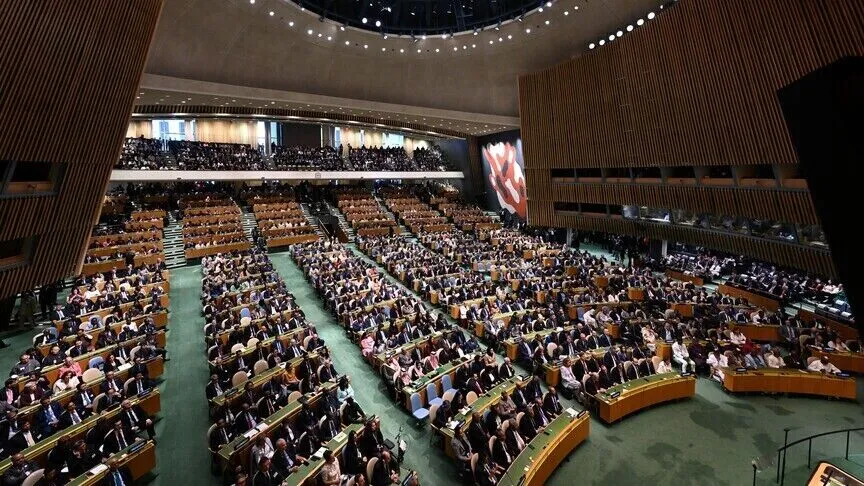
Ministers from five Muslim-majority nations met at the UN General Assembly to discuss Kashmir, reaffirming their support for Kashmiri self-determination under international law. The Frontier Post reported that officials from Azerbaijan, Pakistan, Türkiye, Saudi Arabia and Niger called for a peaceful resolution and improved India-Pakistan relations, while expressing alarm over the detention of Kashmiri political leaders.
The Organization of Islamic Cooperation's Contact Group also welcomed a ceasefire following May's military clashes and urged both sides to exercise restraint. Outlook India noted that India swiftly rejected the group's comments, calling them unwarranted and stating the OIC has no jurisdiction over what New Delhi considers an internal matter.
Self-Determination as the Path to Peace
The OIC framed Kashmiri self-determination as an "inalienable" right and the foundation for lasting regional stability. The Frontier Post reported that OIC Secretary-General Ismail Ould Cheikh Ahmed emphasized this principle as essential to resolving South Asia's broader tensions. Azerbaijan's Foreign Minister Jeyhun Bayramov stressed the importance of international law and the UN Charter in building regional peace.
Pakistan's Foreign Minister Ishaq Dar characterized Jammu and Kashmir as an "internationally recognized dispute" under active UN Security Council review. News on Air noted that Dar accused India of attempting to alter the territory's demographic, political and cultural makeup, a claim New Delhi dismissed as "factually incorrect."
Alarm Over Detained Kashmiri Leaders
The ministers expressed serious concern over the detention and denied bail for several prominent Kashmiri figures, including activist Yasin Malik, separatist leader Asiya Andrabi and cancer patient Shabbir Shah. The Statesman reported that these cases highlighted broader concerns about political imprisonment in Indian-administered Kashmir. The group called for immediate international attention to what it views as systematic rights violations.
A spokesperson for Shamim Shawl, leader of the All Parties Hurriyat Conference, declared: "The international community cannot remain silent while the basic human rights of millions are being trampled upon." DNA India noted that Shawl traveled from Geneva after presenting evidence of alleged abuses—including extrajudicial killings, disappearances and land seizures—to the UN Human Rights Council.
India Rejects OIC Criticism as Overreach
New Delhi fired back quickly, rejecting the OIC's involvement as inappropriate meddling in sovereign affairs. News on Air reported that India's Ministry of External Affairs called the group's remarks "unwarranted and factually incorrect," emphasizing that Kashmir is an internal matter beyond the OIC's authority. The government drew no distinction between the two sides' positions on the dispute.
Outlook India noted that India urged the OIC to counsel Pakistan instead, pointing to cross-border terrorism and calling on Islamabad to address security threats. The swift rebuke showed New Delhi's unwillingness to engage with multilateral criticism on Kashmir, even as international attention to the issue persists at the UN.
Sentiment
Mostly NegativeNEGATIVENEUTRALPOSITIVE
Publishers
17
Articles
22
Reach
39
A
AnonymousAuthor


