Ancient Mars Water Episodes
NASA Perseverance Rover Finds Three Distinct Water Episodes in Mars Rocks
Anonymous
Key Points
1
Perseverance reached the Margin Unit in September 2023, after orbital observations had led scientists to expect sedimentary rocks formed along Jezero’s ancient lakeshore because carbonates commonly develop in shallow aquatic environments on Earth.
2
The study cannot determine the ages of the individual water-related alteration events; it establishes their sequence and chemical differences rather than when they occurred.
3
SuperCam identified the rocks’ chemistry by firing a laser at targets as far as 21 feet (6.5 meters) away and analyzing the light emitted by the resulting plasma; more than 185 bedrock targets were examined across the unit.
4
Candice Bedford said the discovery reflects how orbital expectations often fail to capture Mars’ geological complexity: “Mars constantly throws surprises at you. It is very rare that things are as we expect them to be from orbital data.”
5
The Margin Unit’s importance is tied partly to the record-keeping ability of igneous minerals: crystals can preserve details from the time the rock formed, allowing scientists to reconstruct later chemical alteration even though the original rock was not sedimentary.
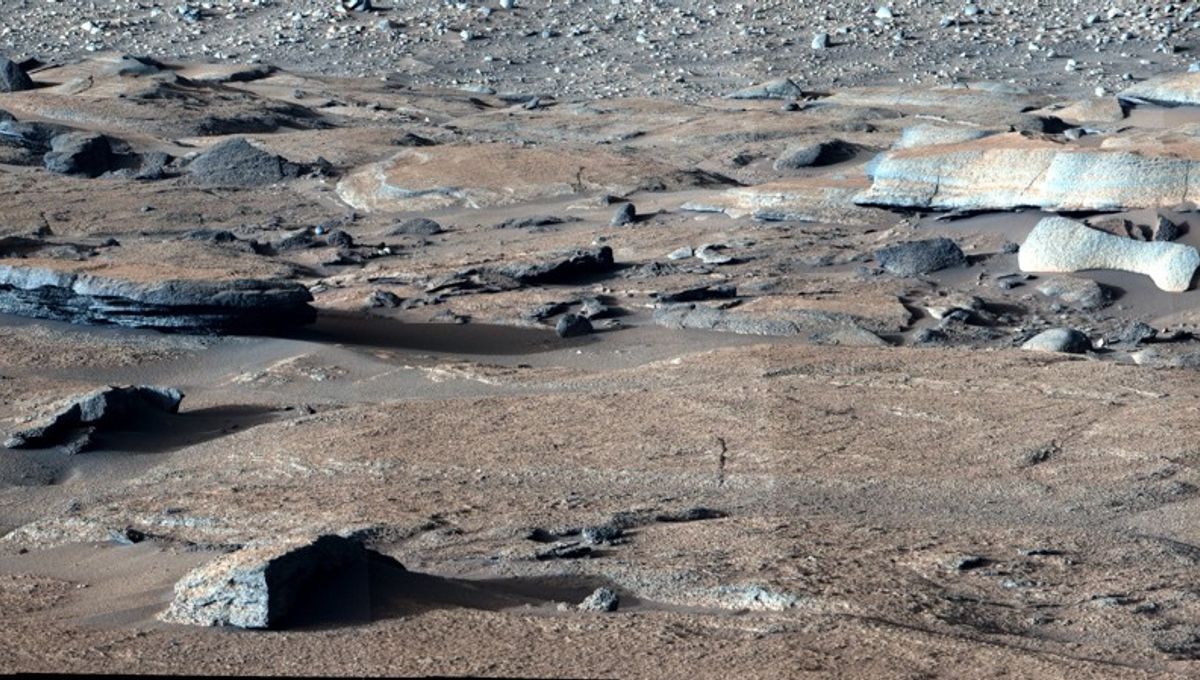
NASA's Perseverance rover discovered that Mars' Margin Unit—a rocky formation along Jezero Crater's inner rim—recorded at least three distinct episodes of water interaction billions of years ago. Technology Networks reports the rover's SuperCam laser instrument analyzed over 185 rock targets and found that carbon dioxide-rich fluids, then lakes or groundwater, and finally heated hydrothermal fluids each left their chemical fingerprints on the igneous rocks, revealing a surprisingly complex water history that defies earlier expectations.
The discovery matters because it shows early Mars had multiple, chemically different water systems moving through the same region. Pasadena Now notes scientists had expected sedimentary lakeshore deposits but instead found olivine-rich igneous rock—a finding that reveals Mars' geology is far more intricate than orbital data suggested.
Three Water Events Left Chemical Clues in Rock
The Margin Unit experienced three water-related alteration phases, each distinct and sequential. IFLScience explains that carbon dioxide-rich fluids first created carbonate deposits in rock fractures. Later, lake or groundwater altered those minerals and introduced silica. Finally, heated hydrothermal fluids formed veins containing fluorite and calcium sulfate—minerals that form in hot, underground fluid systems. Each phase left a different chemical signature.
The study cannot pinpoint when each event occurred, only their order and chemistry. Newsy Today reports that igneous minerals have a special advantage: their crystals preserve details from when the rock formed, allowing scientists to reconstruct later chemical changes even though the original rock wasn't sedimentary.
Orbital Data Missed What Rovers Discover on the Ground
Before Perseverance reached the Margin Unit in September 2023, orbital observations led scientists to expect sedimentary rocks like those formed on Earth's shallow lake shores. The actual geology told a different story. According to researcher comments, "Mars constantly throws surprises at you. It is very rare that things are as we expect them to be from orbital data." Ground-level investigation revealed complexity that satellites simply couldn't detect.
This gap between expectation and reality underscores why rovers matter. English Ratopati notes that SuperCam's laser spectroscopy examined bedrock from as far away as 21 feet (6.5 meters), vaporizing tiny surface spots and analyzing the light emitted to determine rock chemistry. No orbiting instrument can match that precision.
Early Mars Hosted Diverse Water Systems for Habitability
The three water episodes—each chemically and geologically distinct—paint a portrait of an early Mars where liquid water cycled through rocks in multiple forms: as shallow lakes, as groundwater flowing through fractures, and as hot hydrothermal fluids deep underground. This diversity matters for habitability. JPL Discovery explains that such varied water systems would have created different chemical environments where early Martian life, if it ever emerged, could have found multiple ecological niches.
Sentiment
Mostly PositiveNEGATIVENEUTRALPOSITIVE
Publishers
16
Articles
9
Reach
25
A
AnonymousAuthor


