Mars Housing Breakthrough
Researchers develop recyclable Mars housing material using local regolith and engineered yeast.
Anonymous
Key Points
1
The initial printed prototypes remain very small—about 45 millimeters tall and 30 millimeters wide, roughly the size of a wine cork—despite the material’s larger construction potential.
2
Testing measured the material’s compressive strength at approximately 10–12 megapascals, comparable to low-grade concrete.
3
Lead researcher Jishen Qiu said the material is strong enough for a one- or two-story building on Earth, whose gravity is three times that of Mars, suggesting that taller structures could potentially be built under Martian gravity.
4
Qiu said the idea was inspired by freeze-dried fruit becoming harder: “My inspiration came from freeze-dried fruits that become harder. So I asked myself if we can take advantage of that and make some materials.”
5
The proposed approach addresses Mars’s severe construction environment, where temperatures can fall to about −81 degrees Fahrenheit and the surface is exposed to near-vacuum conditions and radiation, by using freeze-drying rather than conventional energy-intensive processing.
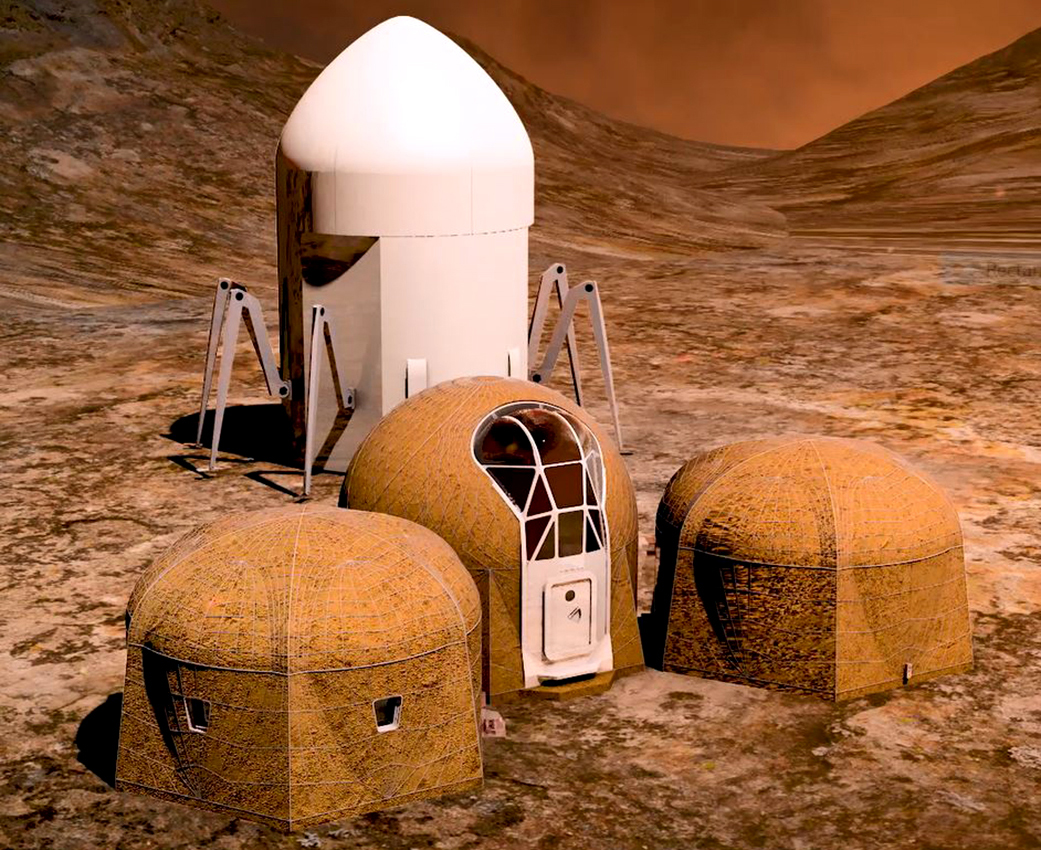
Researchers at Hong Kong University of Science and Technology have designed a radical new building material for Mars: 3D-printed shelters made from Martian rock, gelatin, and genetically engineered yeast. Floyd The mixture achieves compressive strength around 10–12 megapascals—comparable to low-grade concrete—and the Martian environment itself does the heavy lifting. Extreme cold and near-vacuum conditions freeze-dry the printed material into a lightweight, porous structure that could support one- or two-story buildings on Earth and potentially much taller structures under Mars's weaker gravity.
The breakthrough sidesteps the energy-intensive construction methods used on Earth. Lead researcher Jishen Qiu drew inspiration from freeze-dried fruit, which becomes harder as it dries. "My inspiration came from freeze-dried fruits that become harder," Qiu explained. "So I asked myself if we can take advantage of that and make some materials." The yeast produces adhesive proteins modeled on those mussels use to bond to rocks, while gelatin binds everything together and feeds the microbes.
Tiny Prototypes Show Big Structural Promise
So far, the team has printed only small domes—roughly 45 millimeters tall and 30 millimeters wide, about the size of a wine cork. Floyd Yet the compressive strength tests show the material can handle real loads. Because Mars has only one-third of Earth's gravity, structures that support one or two stories on our planet could potentially rise much higher on Mars. Qiu said the material is "strong enough for a one- or two-story building on Earth," with implications for significantly taller Martian construction.
Freeze-Drying Replaces Power-Hungry Construction
Mars presents a brutal building environment: temperatures plummet to around −81 degrees Fahrenheit, and the surface sits exposed to near-vacuum conditions and radiation. Breeze Traditional construction requires ovens, kilns, or chemical reactions that demand enormous energy. The new method lets Mars itself do the work. The extreme cold and low pressure automatically freeze-dry the printed mixture, creating the final material without any energy input from humans.
Critical Questions Remain for Martian Deployment
The research is still early-stage, and major hurdles remain unsolved. Purdue Scientists must figure out whether genetically engineered yeast can survive Martian conditions, how to sustainably supply gelatin on the Red Planet, and what water requirements the process demands. The printing apparatus itself also needs to function reliably in the harsh Martian environment. Until these practical challenges are resolved, the technology remains a promising laboratory concept rather than a ready-made solution for future Mars colonists.
One major advantage: the material is recyclable and reusable. Guam If a structure breaks down or needs to be repurposed, the components could theoretically be recombined and re-printed. This circular approach could reduce waste and lower long-term resource demands for expanding settlements on Mars, making the vision of sustainable Martian construction more feasible.
Sentiment
Mostly PositiveNEGATIVENEUTRALPOSITIVE
Publishers
13
Articles
85
Reach
98
Topics
A
AnonymousAuthor


