Infrared Detector Trade-offs
Cooled Versus Uncooled Infrared Detectors Balance Sensitivity Against Cost and Power
Anonymous
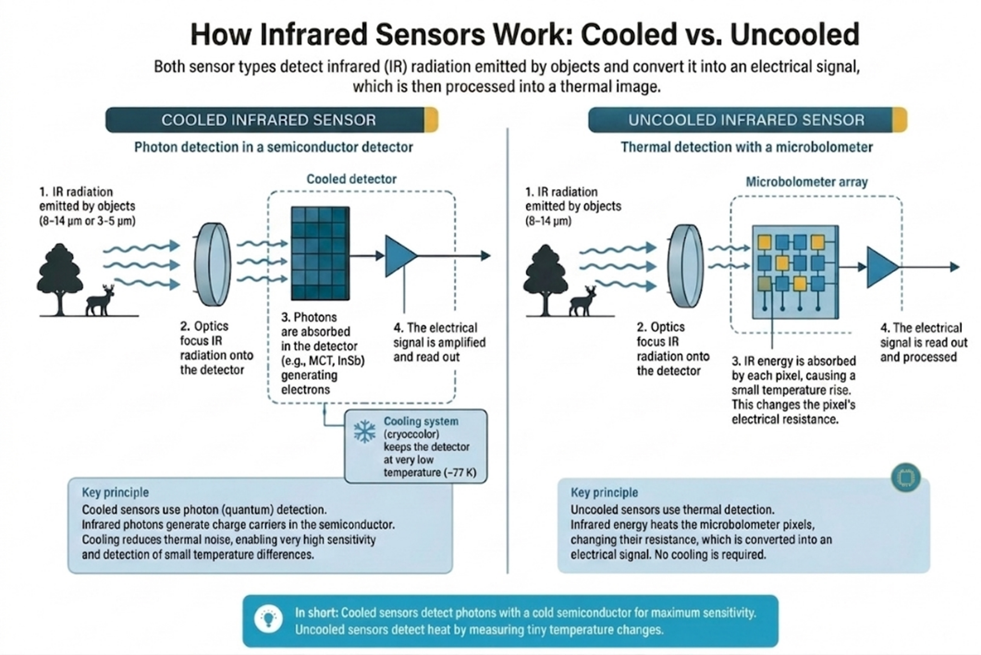
Choosing between cooled and uncooled infrared detectors is a foundational decision that affects performance, cost, size, power use and maintenance. Uncooled detectors use microbolometers—commonly made with vanadium oxide or amorphous silicon—to measure temperature-driven resistance changes without a cooling system. Their low cost, compact design, low power consumption and maintenance-free operation make them common in handheld thermal imagers, automotive night vision, drones and security systems. However, room-temperature thermal radiation creates additional noise, typically limiting sensitivity to about 30–60 mK, which is adequate for most industrial and surveillance applications but may not suit tasks requiring detection of very weak temperature differences.
Key Points
1
A representative 640×512 uncooled focal-plane array in a standard ceramic LGA package can consume less than 1 watt and weigh under 50 grams, illustrating its suitability for lightweight, battery-powered equipment.
2
In a microbolometer, a CMOS readout circuit converts the temperature-induced resistance change in the sensing material into a voltage signal.
3
The stated 30–60 mK NETD range corresponds to distinguishing temperature differences of approximately 0.03–0.06°C.
Sentiment
Mostly NegativeNEGATIVENEUTRALPOSITIVE
Publishers
5
Articles
24
Reach
29
A
AnonymousAuthor


