Google Earth Reveals Ancient Traps, Meteorite Craters
Google Earth Reveals Ancient Traps, Meteorite Craters
Anonymous
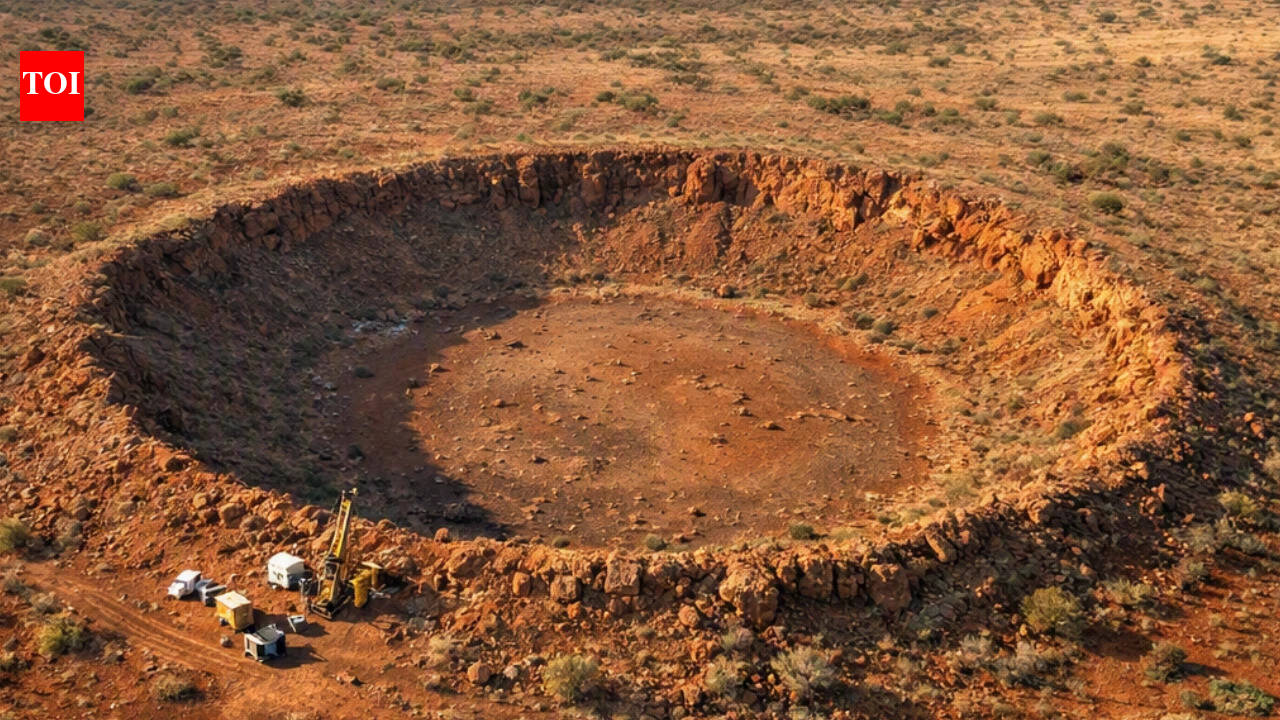
Satellite imagery helped researchers identify previously overlooked geological features in remote deserts. In Egypt, a wheel-shaped mark spotted on Google Earth led scientists to the Kamil crater, a largely pristine, bowl-shaped impact site about 45 meters wide and less than 5,000 years old that scattered roughly 1.7 tons of iron meteorite fragments. Its preserved ejecta pattern offers rare real-world evidence for studying small impacts, which are often eroded or understood mainly through simulations. In Western Australia, a near-perfect circle noticed on satellite images was later confirmed through drilling to be the Hickman Crater, an approximately 260-meter-wide impact structure formed between 10,000 and 100,000 years ago.
Key Points
1
The Kamil crater was identified in 2008 by V. De Michele, then curator of the Natural History Museum in Milan, while he was surveying Google Earth imagery of southern Egypt. The meteorite is officially named Gebel Kamil after a nearby locality.
2
Geophysical studies found that Kamil is about 45 meters wide and 16 meters deep, with a rim approximately 3 meters above the surrounding pre-impact surface; it formed in Cretaceous sandstone belonging to Egypt’s Gilf Kebir Formation.
3
Kamil’s radiating ejecta pattern is significant because such “rayed” formations are common on rocky and icy bodies in space but are rarely preserved on Earth, where erosion usually removes them. Small terrestrial craters under 300 meters across are also uncommon and highly eroded, making the site useful for testing impact simulations.
4
The Western Australian structure was first noticed in July 2007 by Arthur Hickman of the Geological Survey of Western Australia. Researchers inferred that it may have been produced by a projectile roughly 10 meters wide that excavated a crater about 80 meters deep.
5
Because surface evidence alone was inconclusive at Hickman Crater, the Geological Survey of Western Australia undertook a 2012 drilling project with mining company Atlas Iron. The drilling confirmed a circular structure about 260 meters across, with a rim rising roughly 30 meters above a flat floor.
Sentiment
Mostly NegativeNEGATIVENEUTRALPOSITIVE
Publishers
6
Articles
4
Reach
10
A
AnonymousAuthor


