Warm-Blooded T. Rex Discovered
New Fossil Analysis Reveals T. Rex Had a Human-Like Body Temperature
Anonymous
Key Points
1
UCLA researchers reduced the amount of fossil material required for the analysis by roughly 90%, enabling the Natural History Museum of Los Angeles County to provide portions of two teeth from its largely complete specimen, Thomas.
2
The Los Angeles Times reported an estimated temperature of 97.3°F with an uncertainty of plus or minus 4.5°F, and quoted UCLA geobiologist Robert Eagle calling the result an “unambiguous measurement” of T. rex physiology.
3
The researchers compared enamel from three T. rex teeth with five fossilized crocodile teeth of a similar age, using the crocodiles as an ectothermic reference for interpreting the isotope results.
4
The findings challenge the idea that T. rex would have been restricted to tropical environments: paleontologist Scott Persons said the animal likely could have lived comfortably in subtropical and even mild climates.
5
The result places T. rex below the body temperatures of modern birds: ostriches typically measure about 101–103°F, while chickens are around 105–107°F; Johns Hopkins paleobiologist Jasmina Wiemann called the finding “absolutely spectacular.”
T. rex had a body temperature of about 97°F — nearly identical to humans — according to CNN and SCMP. Researchers analyzed fossilized tooth enamel using rare isotope bonds that form at different rates depending on temperature. This is the first direct measurement of a dinosaur's internal heat and proves the ancient predator was warm-blooded, not cold-blooded like modern reptiles.
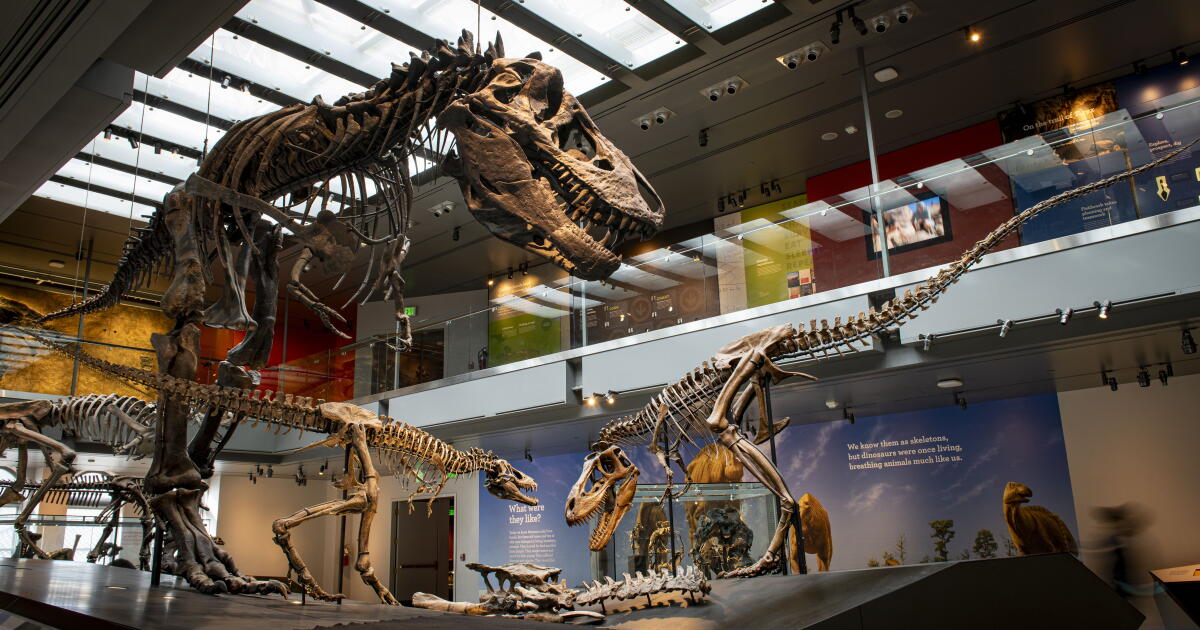
The discovery, published in Science Advances, used teeth from three T. rex specimens, including samples from the Natural History Museum of Los Angeles County's fossil named Thomas. UCLA researchers cut down the material needed by 90%, making it possible to study museum pieces without destroying them. The Los Angeles Times quoted UCLA geobiologist Robert Eagle calling the result an "unambiguous measurement" of how this dinosaur actually lived.
How Scientists Measured a 66-Million-Year-Old Body Temperature
The team measured carbon-13 and oxygen-18 isotope bonds trapped inside tooth enamel. These bonds form at temperature-dependent rates — higher heat creates different chemical patterns than lower heat. CNN reported that scientists compared enamel from three T. rex teeth against five fossilized crocodile teeth from the same era. Crocodiles are cold-blooded, so they served as a reference point for what ectothermic reptiles' isotopes look like.
The uncertainty margin was plus or minus 4.5°F, meaning T. rex likely fell somewhere between 92.8°F and 101.8°F. This narrow range makes the measurement reliable enough to draw solid conclusions about dinosaur metabolism. KRDO noted the University of California, Los Angeles led the study using techniques that analyze chemical signatures preserved in fossilized bone and enamel.
Warm-Blooded Metabolism Powered Active Hunting
A warm-blooded T. rex could move fast, hunt aggressively, and maintain energy even in cooler weather. CNN reported that fossilized footprints found in Alaska suggest these predators thrived in frigid environments — something impossible for cold-blooded reptiles that need external heat to stay active. Warm blood meant T. rex could hunt at dawn, dusk, or during cool nights when cold-blooded prey animals were sluggish.
But this advantage came with a cost: warm-blooded animals need far more food to fuel their bodies. A T. rex burning energy to maintain 97°F would have required constant hunting or scavenging to survive. The metabolic trade-off meant the dinosaur was more active and adaptable, but also hungrier than cold-blooded competitors.
T. Rex Lived in Milder Climates, Not Just Tropical Heat
Previous scientists thought T. rex needed tropical environments to keep warm. Paleontologist Scott Persons challenged that idea, saying the dinosaur likely thrived in subtropical and mild climates too. At 97°F — about 4°F below modern humans — T. rex had enough internal heat to function in cooler regions where 66 million years ago, seasons still existed and temperatures varied.
The temperature was still lower than modern birds: ostriches run at 101–103°F and chickens at 105–107°F. Johns Hopkins paleobiologist Jasmina Wiemann called the finding "absolutely spectacular," noting it rewrites assumptions about how T. rex conquered different ecosystems across North America and adapted to environmental changes during the late Cretaceous period.
Sentiment
Mostly NegativeNEGATIVENEUTRALPOSITIVE
Publishers
29
Articles
182
Reach
211
A
AnonymousAuthor


