Industry Coalition Plans Europe-Wide Hydrogen Truck Rollout
Industry Coalition Plans Europe-Wide Hydrogen Truck Rollout
Anonymous
Key Points
1
Daimler Truck said customers have accumulated nearly 600,000 kilometers in its fuel-cell trucks, while Bosch reported more than 30 million kilometers of road experience with its fuel-cell system.
2
Daimler Truck is preparing its first hydrogen-combustion-engine trucks for market launch in 2026 and says it will invest a mid-three-digit-million-euro amount in hydrogen trucks by the end of the decade.
3
The German policy framework cited by the coalition combines vehicle and refueling support with renewable-fuel incentives and exemptions from zero-emission truck tolls.
4
The coalition has not specified expected continent-wide vehicle or station deployment numbers, hydrogen volumes, or fuel-price targets, meaning the proposed European expansion remains largely prospective beyond Germany’s funding applications.
5
David Cebon, a University of Cambridge mechanical-engineering professor, said it was “completely out of the question” for fleet operators to buy and run hydrogen vehicles, citing their lower energy efficiency compared with alternatives.
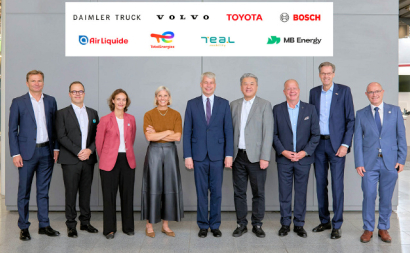
A coalition of major automakers and energy companies is pushing European governments to adopt Germany's hydrogen-truck model to scale fuel-cell vehicles across the continent by 2030. Renewable Energy Magazine reports that Volvo Group, Daimler Truck, Toyota, Bosch, Air Liquide, TotalEnergies, TEAL Mobility and MB Energy want synchronized funding, toll exemptions, and fuel incentives to overcome the industry's core challenge: fleets won't buy trucks without reliable refueling stations, and station builders won't invest without guaranteed demand.
Germany's funding program is already attracting applications for more than 70 high-capacity stations and 800 heavy-duty trucks. Daimler Truck plans to deploy 100 next-generation fuel-cell trucks with customers from late 2026 and is also preparing hydrogen-combustion engines for market launch that same year, with plans to invest a mid-three-digit-million-euro amount by decade's end.
Why Hydrogen Trucks Need Coordinated Infrastructure
The hydrogen industry faces a classic chicken-and-egg problem. Fleet operators won't buy expensive trucks without proven access to refueling stations. Station developers won't build without guaranteed customer volume. The Construction Index notes that the coalition is addressing this by coordinating vehicle production, hydrogen supply, and stations along major freight corridors across Europe.
Germany's approach combines vehicle subsidies with refueling infrastructure support and renewable-fuel incentives. It also exempts hydrogen trucks from zero-emission vehicle tolls, reducing operating costs. This multi-pronged strategy removes obstacles that would otherwise make hydrogen investments too risky for both manufacturers and energy companies.
Daimler's Rapid Progress in Fuel-Cell Trucks
Daimler Truck has accumulated nearly 600,000 kilometers of real-world driving in its fuel-cell trucks, while Bosch reports more than 30 million kilometers of road experience with its fuel-cell system. These miles demonstrate that the technology works reliably in demanding transport applications.
The company plans to launch hydrogen-combustion-engine trucks in 2026 alongside its fuel-cell models. This dual approach gives fleet operators choices based on their specific needs. TT News reports Daimler and Volvo are partnering with technology and energy firms to develop Germany's hydrogen infrastructure as part of their global ambitions.
Infrastructure and Refueling Ready for Scale
Infrastructure partners are building stations capable of serving up to 100 hydrogen trucks daily—enough to support serious fleet operations. These high-capacity stations are designed for long-haul freight corridors where hydrogen shines. The goal is to create a network reliable enough to convince fleets to invest in hydrogen vehicles.
The coalition seeks European Commission backing to replicate Germany's funding success across the continent. However, the group has not yet published specific targets for continent-wide vehicle deployments, station numbers, hydrogen volumes, or fuel-price goals. This means the European expansion remains largely prospective beyond Germany's existing funding applications.
Skepticism Persists Over Cost and Efficiency
Critics question whether hydrogen can compete economically with battery-electric trucks. David Cebon, a University of Cambridge mechanical-engineering professor, said it was "completely out of the question" for fleet operators to buy and run hydrogen vehicles, citing their lower energy efficiency compared with alternatives.
The coalition frames hydrogen as complementary to battery trucks for specific use cases: long-haul operations requiring extended range, heavy payloads, and rapid refueling. Korea JoongAng Daily notes that hydrogen-powered vehicles are making a comeback in the global auto industry, particularly for heavy-duty transport. Success will depend on whether costs fall enough to match battery economics within the next few years.
Sentiment
Mostly PositiveNEGATIVENEUTRALPOSITIVE
Publishers
13
Articles
21
Reach
34
A
AnonymousAuthor


