Nationwide Elections Underway
Russia Begins Nationwide Elections Amid the Ongoing War in Ukraine and Crackdown on Opposition
Anonymous
Key Points
1
Beyond the State Duma contest, elections are being held for 23,000 regional legislative seats across 39 Russian constituent entities; regional leaders are being chosen directly in eight regions and by regional parliaments in three.
2
Ten parties are participating in the State Duma election, including the Communist Party, LDPR, New People, A Just Russia–For Truth, the Party of Pensioners for Social Justice, Rodina, the Party of Direct Democracy and the Greens Ecological Party.
3
The anti-war Yabloko party was barred from the election by Russia’s Supreme Court shortly after being registered; Yabloko called the decision political, while authorities cited alleged violations involving foreign financing and copyright.
4
A televised debate in Ryazan highlighted the lack of meaningful competition: none of the six registered candidates appeared, leaving empty podiums in the Russia-1 studio.
5
Moscow voters using online voting or electronic terminals are being offered points redeemable for prizes, an incentive that has intensified criticism of the electronic system’s transparency compared with paper voting.
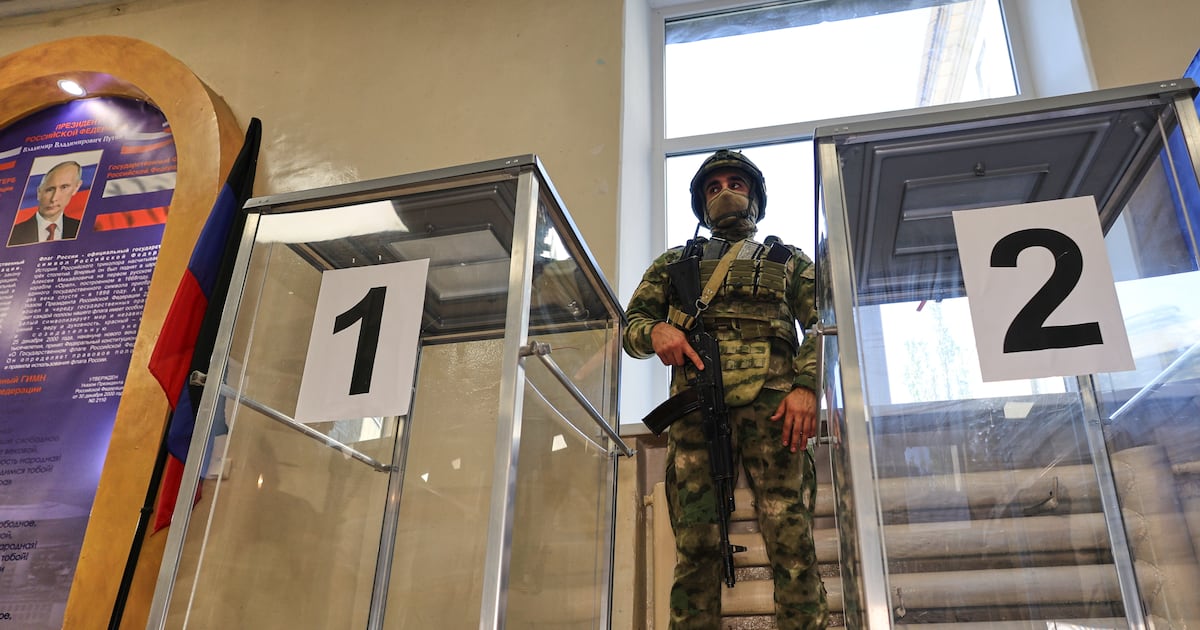
Russia is holding its first parliamentary election since invading Ukraine in February 2022, with voters selecting the 450 members of the State Duma across a three-day window ending Sunday. Radio Free Europe reported that President Vladimir Putin declared in a pre-election address: "Your choice and your will once again demonstrate that millions of people stand behind our troops." The vote serves as a test of public support for the war effort amid economic pressure and Ukrainian attacks, though the Kremlin has squeezed out genuine opposition—including barring the anti-war Yabloko party from the ballot.
United Russia, Putin's party, is expected to retain overwhelming control, while ten officially sanctioned parties will compete. For the first time, residents in Russian-occupied Ukrainian territories are voting in State Duma elections, a move CNN characterized as part of Kremlin efforts to cement territorial gains and project legitimacy for its war effort.
Anti-War Opposition Barred as Yabloko Party Faces Ban
Russia's Supreme Court invalidated the registration of Yabloko, the country's only openly anti-war party, shortly after it was approved for the ballot. Radio Free Europe reported that authorities cited alleged violations involving foreign financing and copyright infringement. Yabloko condemned the decision as purely political punishment, but the ban left the field dramatically narrowed for voters opposed to the Ukraine invasion.
The exclusion highlights the Kremlin's control over electoral competition. CNN noted that a televised candidate debate in Ryazan underscored the lack of meaningful opposition: all six registered candidates failed to appear, leaving empty podiums beside state TV anchor Elizaveta Dorokhina, who told viewers, "The candidates have not shown up at our studio, so I'll say goodbye for now."
Occupied Ukrainian Territories Vote for First Time in Duma Election
Residents in Russian-occupied regions of Donetsk, Luhansk, Kherson, and Zaporizhzhia are participating in a State Duma election for the first time, following years of mass "passportization" policies that granted Russian citizenship to Ukrainians in seized areas. The Boston Globe reported that Russia is holding these elections in illegally annexed Ukrainian territory in an effort to cement its wartime gains and create a veneer of legitimacy for the occupation.
The move is widely seen as an attempt to normalize Russian rule over conquered territory. The Hindu reported that Kyiv officials have denounced the vote in occupied areas as illegal under international law, calling it a violation of Ukraine's sovereignty and territorial integrity.
Electronic Voting Criticized Over Transparency and Prize Incentives
Moscow is offering residents who vote electronically or use remote voting platforms points redeemable for prizes—an incentive that has intensified scrutiny of the electronic voting system. BBC reported that independent monitors have raised concerns about transparency and the absence of paper trails compared to traditional polling. The prize system, critics argue, artificially inflates turnout figures and obscures the true level of voter participation.
Authorities also reported increasingly severe cyberattacks on Moscow's remote-voting infrastructure and cited disinformation campaigns aimed at disrupting the election. France 24 noted that electoral experts are questioning whether the multi-day voting window and expanded electronic options serve genuine convenience or primarily lower operational costs for state-directed mobilization while restricting independent observer access to polling operations.
State Duma and Regional Contests Shape Legislative Landscape
Beyond the 450-seat State Duma race, Russia is electing 23,000 regional legislative seats across 39 constituent entities and choosing executive leaders in eleven regions—eight through direct gubernatorial elections and three through regional parliaments. NewsCord reported that ten parties are competing in the State Duma election, including the Communist Party, LDPR, New People, A Just Russia–For Truth, and the Greens Ecological Party.
United Russia, which dominates the current Duma, is virtually assured of maintaining its supermajority, ensuring Putin retains unchecked legislative authority for his war agenda. France 24 characterized the election as a mechanism for the Kremlin to claim overwhelming public backing for its military operations while eliminating the friction of genuine parliamentary opposition.
Sentiment
Mostly NegativeNEGATIVENEUTRALPOSITIVE
Publishers
26
Articles
77
Reach
103
A
AnonymousAuthor


