Proposed Israel Bomb Sale
Trump Administration Prepares $2.8 Billion Munitions Package for Israel Despite Controversy
Anonymous
Key Points
1
The proposed package would be funded by American taxpayers, according to reporting based on The Washington Post’s account.
2
The proposed sale comes amid questions about congressional oversight: a separate $2.04 billion munitions deal approved in 2025 reportedly bypassed normal congressional review procedures.
3
Public support for Israel has declined, particularly among Democrats: a June Quinnipiac poll found that 48% of voters and 66% of Democrats believed the United States was too supportive of Israel, compared with 16% and 20%, respectively, in 2017.
4
Former U.S. Army explosive-ordnance-disposal technician Trevor Ball said the MK-84 is used to destroy entire buildings: “They do like to use them a lot when they’re trying to target any building. If Hezbollah or whoever is in a building, an MK-84 will bring down the whole building.”
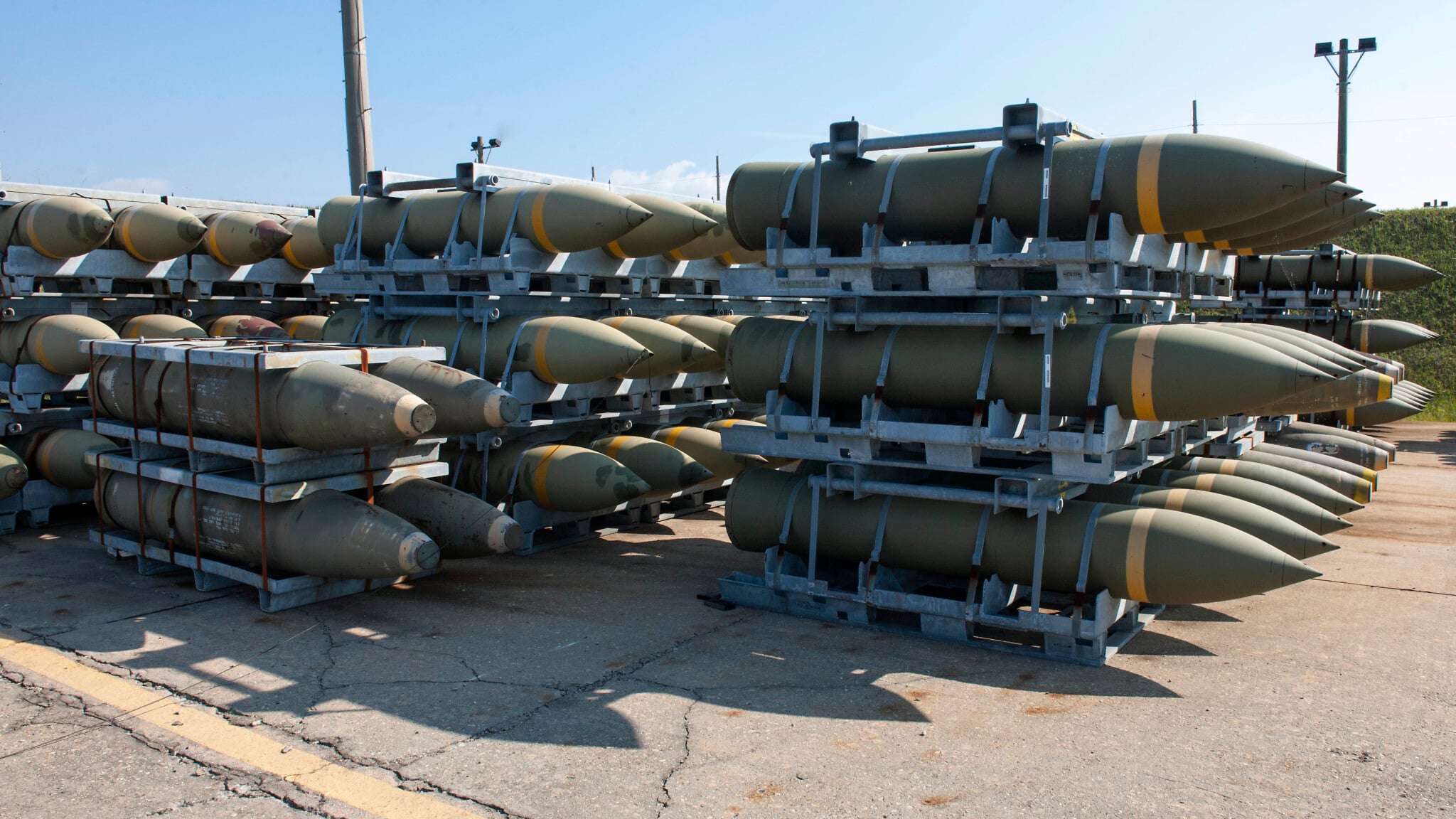
The Trump administration is preparing a proposed $2.8 billion munitions package for Israel containing 40,000 heavy bombs—20,000 MK-84s and 20,000 BLU-117s—plus 20,000 penetrator warheads, Washington Post reported. The weapons can destroy entire buildings and penetrate reinforced concrete, raising concerns about civilian harm in densely populated Gaza and Lebanon. The deal represents among the largest U.S. transfers of 2,000-pound bombs to Israel in recent years.
President Biden paused shipments of such bombs in May 2024 over civilian casualty fears, but deliveries resumed after Trump took office in January 2025. A June Quinnipiac poll found 48% of voters and 66% of Democrats now believe the U.S. is too supportive of Israel, compared to 16% and 20% respectively in 2017.
What These Bombs Actually Do
The MK-84 is a 2,000-pound general-purpose bomb used to destroy entire buildings. Former U.S. Army explosive-ordnance-disposal technician Trevor Ball said: "They do like to use them a lot when they're trying to target any building. If Hezbollah or whoever is in a building, an MK-84 will bring down the whole building." The BLU-117 penetrator bombs can smash through reinforced concrete structures like bunkers.
Biden Paused These Weapons, Trump Reversed Course
In May 2024, President Biden temporarily halted shipments of 2,000-pound bombs to Israel due to civilian harm concerns during Gaza operations, Star Tribune reported. After Trump took office in January 2025, he reversed the hold and cleared pending deliveries. This new $2.8 billion package signals an even larger commitment to supplying such munitions.
The Trump administration declined to comment on the pending sale beyond saying all foreign arms deals move through appropriate processes. A U.S. official confirmed the details on condition of anonymity. Congressional committees have been informally notified but the deal has not yet undergone full congressional review.
Congress May Block or Condition the Deal
The proposed sale sets up a high-stakes legislative test. Congressional Democrats view informal notification as a key moment to decide whether to block or add conditions to Foreign Military Financing. A separate $2.04 billion munitions deal approved in 2025 reportedly bypassed normal congressional review procedures, raising oversight questions.
Public opinion has shifted sharply against unconditional support. Among registered Democrats, 66% now believe the U.S. backs Israel too much—a jump from just 20% in 2017. This tighter public opinion could embolden lawmakers to challenge the $2.8 billion package or demand accountability measures for civilian protection.
Rights Groups Warn of Urban Warfare Risks
Military experts warn that 2,000-pound bombs generate fragment dispersion over thousands of feet and leave wide craters—making them unsuitable for dense urban areas like Gaza and southern Lebanon. Human rights advocates point out Israel previously dropped such munitions near designated safe zones in Gaza, fueling concerns about civilian casualties.
International advocacy organizations view the deal as U.S. complicity in potential harm to civilians. The weapons package would be funded by American taxpayers through Foreign Military Financing, meaning U.S. citizens directly subsidize the manufacturing and shipment of these heavy munitions whether they support the policy or not.
Sentiment
Mostly NegativeNEGATIVENEUTRALPOSITIVE
Publishers
94
Articles
482
Reach
576
A
AnonymousAuthor


