Venus Destroyed Its Own Moon
New Study Suggests Venus Cannibalized Its Own Ancient Moon Through Slow Rotation
Anonymous
Key Points
1
Venus takes about 243 Earth days to complete one rotation, a rate that the study identifies as central to driving a hypothetical moon inward rather than away from the planet.
2
Lead researcher Stephen Kane said he was surprised that simulations covering a broad range of possible scenarios produced largely the same outcome: an eventual inward spiral and collision with Venus.
3
Earth’s Moon is receding from Earth by roughly four centimeters per year because Earth’s faster rotation transfers energy to the Moon, underscoring the contrast with Venus’s proposed moon-destroying dynamics.
4
The Moon–Venus event was not identical everywhere: observers in parts of central and southern India saw a lunar occultation in which the Moon temporarily covered Venus, while Mangaluru, outside the occultation path, saw the two objects remain visibly close together.
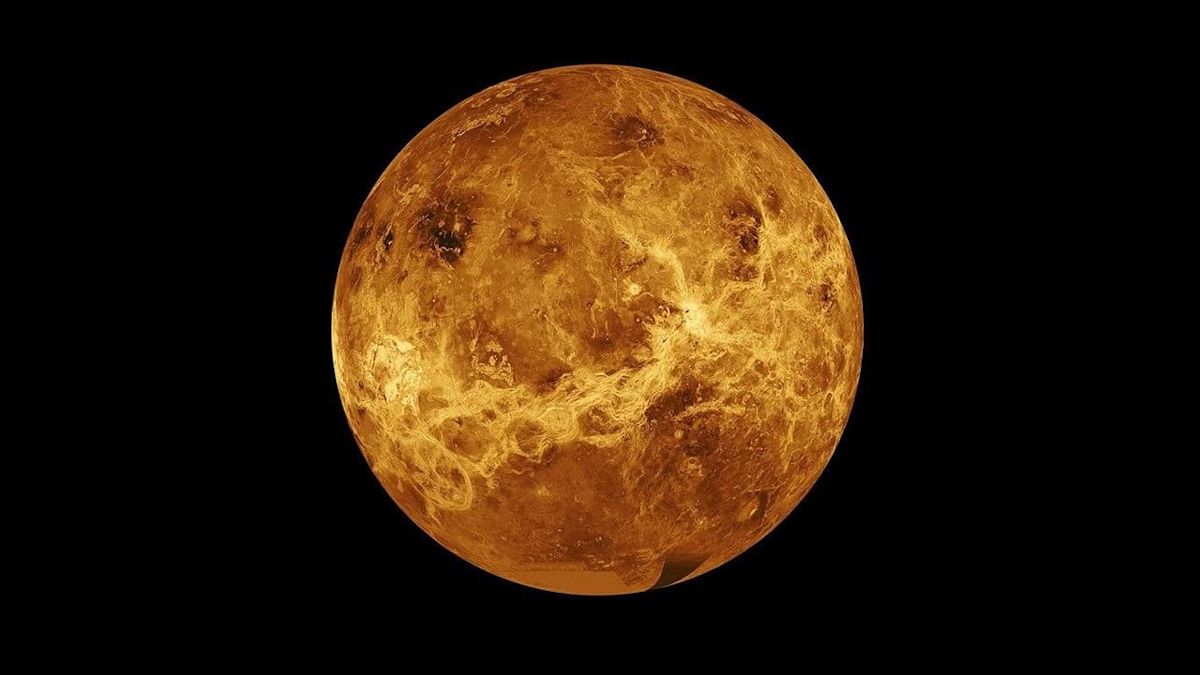
Venus may have cannibalized its own moon billions of years ago, according to a new study from the University of California, Riverside. Yahoo Tech reports that the planet's exceptionally slow rotation—taking 243 Earth days to spin once—would have pulled any orbiting moon inward until it crashed into the planet. The research offers a simpler explanation for why Venus, Earth's near-twin in size and mass, remains moonless today.
Computer simulations show that a Venusian moon likely would have spiraled inward and collided with the planet within the first 1.7 billion years of the solar system, depending on the moon's size. UC Riverside researcher Stephen Kane noted his surprise: the simulations produced consistent results across many different scenarios. The findings differ sharply from Earth, where our Moon drifts away at about four centimeters per year because Earth spins much faster.
How Venus Destroys Its Moon Through Slow Rotation
Venus rotates so slowly that it reverses the normal direction of tidal energy transfer. Instead of pushing a moon outward, as Earth's faster spin does, Venus's crawl drags any satellite inward. Stephen Kane said: "My study shows Venus didn't require a catastrophe to arrive at what we can see today. It turns out the gravity of the planet itself combined with the rate at which it spins naturally caused the moon to collapse on top of it." The simulations ran thousands of scenarios covering different moon masses and starting positions—all ended in collision.
A heavier hypothetical moon would have crashed faster. A moon twice Earth's Moon's mass would spiral down in roughly 30 million years. A lighter moon—half Earth's Moon's mass—could survive up to 1.7 billion years before impact. Geekspin reported that Kane emphasized the surprise: "The moon is transferring angular momentum inward instead of outward. It causes the moon's orbit to catastrophically collapse."
Why Venus Looks Like Earth But Lost Its Moon
Planetary scientists have long puzzled over why Venus—nearly identical to Earth in size, mass, and internal heat—never kept a natural satellite. Daily Beirut notes that earlier theories offered two extremes: either Venus never formed a moon in the first place, or a massive secondary impact stripped one away. Kane's new research provides a third, simpler answer rooted in basic physics: Venus's slow spin makes moon-keeping impossible.
If Venus did form a moon during the solar system's violent early days, that moon was doomed from the start. Tidal forces from the planet's slow rotation would have inexorably pulled it inward. No catastrophic impact needed. The study doesn't prove Venus ever had a moon—only that if it did, survival was statistically improbable. This natural planetary mechanism may explain why Venus diverged so drastically from Earth, becoming the hellish, superheated world we see today.
Recent Venus-Moon Alignment Caused No Confusion
On September 14, observers across Asia witnessed the Moon pass directly in front of Venus—a rare occultation that coincided with publication of Kane's study. New Indian Express reported that parts of central and southern India saw the lunar occultation, while cities like Mangaluru outside the occultation path watched Venus and the Moon remain visibly close. These were purely line-of-sight alignments from Earth.
Media coverage linked these visual events to the UC Riverside research, creating potential confusion. Astronomers clarified that Venus-Moon conjunctions are temporary alignments in Earth's sky and carry no significance for whether Venus ever possessed an actual moon. The recent event simply illustrated Earth's unique vantage point—Venus still has no natural satellite today, and likely never retained one long enough to cause observable effects.
What This Means for Finding Moons Around Distant Planets
Kane's findings reshape how astronomers evaluate exoplanets orbiting other stars. Many distant rocky worlds rotate slowly and closely orbit their parent stars—conditions similar to Venus. The UC Riverside study suggests these slow-rotating planets should *not* be expected to harbor stable moons, even if they formed them early on.
Large moons stabilize a planet's tilt and drive tidal heating, both critical for habitability. A moon lost to inward spiral would have deprived Venus of these benefits. Understanding how planetary rotation determines moon retention helps astronomers narrow the search for potentially habitable worlds—and recognize that some planets, no matter how Earth-like, are fundamentally incompatible with keeping moons.
Sentiment
Mostly NegativeNEGATIVENEUTRALPOSITIVE
Publishers
37
Articles
62
Reach
99
A
AnonymousAuthor


