Study Supports Direct-Collapse Origins of Early Black Holes
Study Supports Direct-Collapse Origins of Early Black Holes
Anonymous
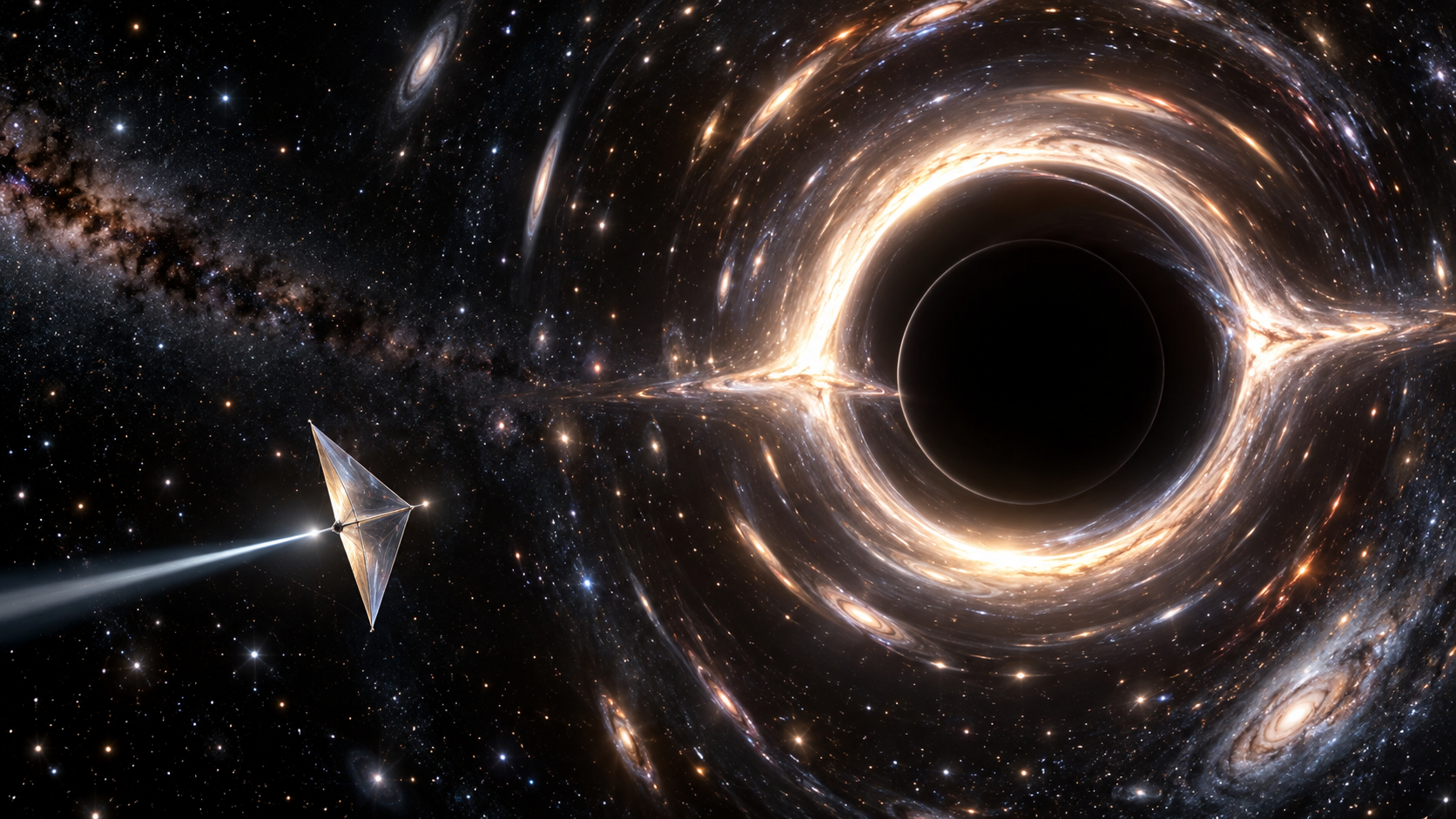
Researchers are exploring both the origins of black holes and the possibility of studying one up close. An international team led by Alessandro Trinca used high-resolution cosmological simulations to support the idea that massive clouds of gas collapsed directly into heavy black-hole seeds in dense regions of the early Universe, helping explain how supermassive black holes emerged less than a billion years after the Big Bang. The findings were prompted in part by the James Webb Space Telescope’s discovery of compact “Little Red Dots” and other early galaxies containing apparent supermassive black-hole seeds, challenging models based solely on stellar remnants. Separately, a speculative mission concept envisions laser-powered, gram-scale probes traveling at about one-third the speed of light to a potentially nearby black hole, although finding an isolated black hole and slowing the probes into orbit remain major obstacles. Such a mission could test Einstein’s description of spacetime, investigate whether event horizons exist and search for changes in fundamental constants.
Key Points
1
More than 90% of black holes in the Milky Way’s Galactic disk could be isolated rather than part of a binary system, making nearby candidates exceptionally difficult to detect.
2
The proposed mission would use multiple probes: one could study the black hole’s event-horizon region, while two probes could make comparative measurements to test Einstein’s Kerr description of spacetime.
3
The black-hole mission’s most difficult technical problem may be braking: a probe arriving at a substantial fraction of light speed would need to transition from an unbound flyby trajectory into a bound orbit around the black hole.
4
The early-Universe study examined whether dark-matter merger histories and cosmic overdensities—regions unusually rich in gas, dust and stars—created favorable environments for direct-collapse black-hole seeds.
5
The researchers combined high-resolution N-body cosmological zoom-in simulations using the GIZMO code with the Cosmic Archaeology Tool semi-analytic model to investigate the formation environments of the early black-hole seeds; the work was published in the Monthly Notices of the Royal Astronomical Society.
Sentiment
Mostly NegativeNEGATIVENEUTRALPOSITIVE
Publishers
5
Articles
5
Reach
10
Topics
A
AnonymousAuthor


