Black Holes Launch Jets at Two Feeding Thresholds
Black Holes Launch Jets at Two Feeding Thresholds
Anonymous
Key Points
1
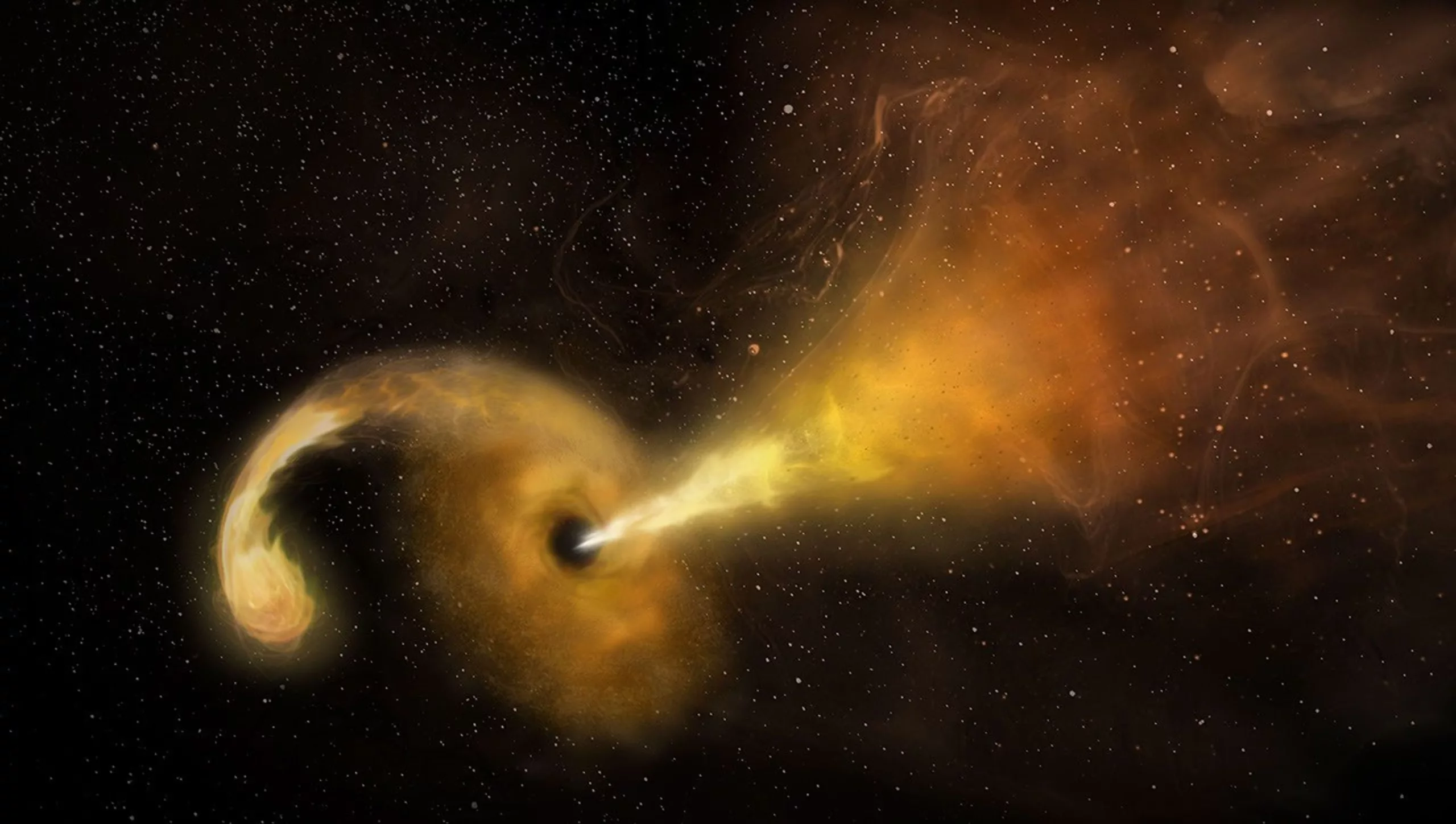
Only about half of a disrupted star is eventually swallowed by the black hole; the remaining material is expelled in jets and outflows.
2
The study’s authors said radio observations were essential because radio is the only wavelength that allows astronomers to watch the jets and outflows move outward.
3
Although the team analyzed 20 tidal disruption events, it was able to reliably model both the feeding rate and radio-jet timing for 10 of them.
4
The observations combined facilities in the United States, Australia, India and South Africa, along with space-based telescopes, underscoring the study’s international and multi-observatory scope.
5
Lead researcher Adelle Goodwin said the outflows can be large enough to influence the evolution of an entire galaxy, not merely the immediate environment around the black hole.
Black holes are "very messy eaters," and scientists have now figured out when they "burp" powerful jets into space. Curtin University researchers analyzed 20 tidal disruption events—instances where black holes tear apart stars—and discovered jets launch at two specific feeding thresholds: right after a black hole reaches extreme hunger, or much later when feeding drops to about 2% of the Eddington limit. The pattern holds across all black hole sizes, from stellar-mass objects to supermassive giants.
Only half the disrupted star gets swallowed; the rest escapes in jets and outflows. Lead researcher Adelle Goodwin said these outflows can be powerful enough to shape entire galaxies, not just the region around the black hole. Tech Explorist reports the international team used radio telescopes across the United States, Australia, India, and South Africa, plus space-based instruments, to track the jets as they moved outward.
Why Radio Observations Unlock the Mystery
Radio wavelengths are the only way to watch black hole jets in real time. Unlike visible light or X-rays, radio signals cut through dust and gas clouds that would otherwise block the view. Newsbytes explains that Goodwin's team relied on radio data to measure how fast the jets expanded and when they first appeared. This allowed them to match jet timing with the feeding rate at each moment.
Two Feeding Rates Trigger Jet Launch
The study found jets emerge at two distinct moments in a black hole's feeding cycle. First, jets can launch almost immediately after a black hole reaches peak hunger—called the Eddington limit, the rate at which gravity and radiation pressure balance. Second, jets appear again much later, when the black hole's appetite drops sharply to just 2% of that maximum rate. This two-stage pattern suggests a single universal mechanism drives all black hole jets.
A Universal Rule Across All Black Hole Sizes
The breakthrough is that this feeding rule works the same way whether the black hole weighs as much as a star or billions of suns. Times of India reports the team successfully modeled feeding rates and jet timing for 10 of the 20 tidal disruption events studied. This consistency across vastly different scales suggests black holes follow one fundamental physics principle for launching jets, regardless of their mass.
Jets Shape the Fate of Entire Galaxies
Black hole jets are no small affair. Goodwin emphasized that these outflows can influence the evolution of entire galaxies over cosmic timescales. The expelled material can heat gas, stop star formation, or redistribute matter across thousands of light-years. Understanding when jets fire helps astronomers predict these galaxy-altering events and plan observations with radio telescope networks worldwide.
Sentiment
Mostly NegativeNEGATIVENEUTRALPOSITIVE
Publishers
15
Articles
7
Reach
22
Topics
A
AnonymousAuthor


