Tejas Jet Delivery Timeline
India Sets 2033 Timeline For 97 Tejas Fighter Jets Amid Ongoing Delays
Anonymous
Key Points
1
HAL has established a third Tejas production line at its Nashik facility, adding capacity for eight aircraft annually and raising the company’s total LCA production capacity to 24 aircraft per year.
2
The original 40-aircraft Tejas Mk1 fleet consists of 16 Initial Operational Clearance fighters, 16 Final Operational Clearance fighters and eight twin-seat trainers; the final two trainers due this month will complete that composition.
3
The December 2010 contract for the 16 FOC fighters and eight trainers was originally valued at ₹5,989 crore, but its value was revised to ₹6,542 crore in March 2025 because of the extended delivery schedule.
4
The Mk1A programme faced a reported Astra Mk1 trial failure that led to additional validation; later tests were successful and the missile was cleared for firing, while validation of other beyond-visual-range and standoff weapons remains incomplete.
5
GE Aerospace’s engine delays were compounded by the earlier shutdown of its dedicated F404 production line in Massachusetts; after HAL ordered 99 follow-on engines in 2021, GE had to revive the dormant line and re-engage suppliers.
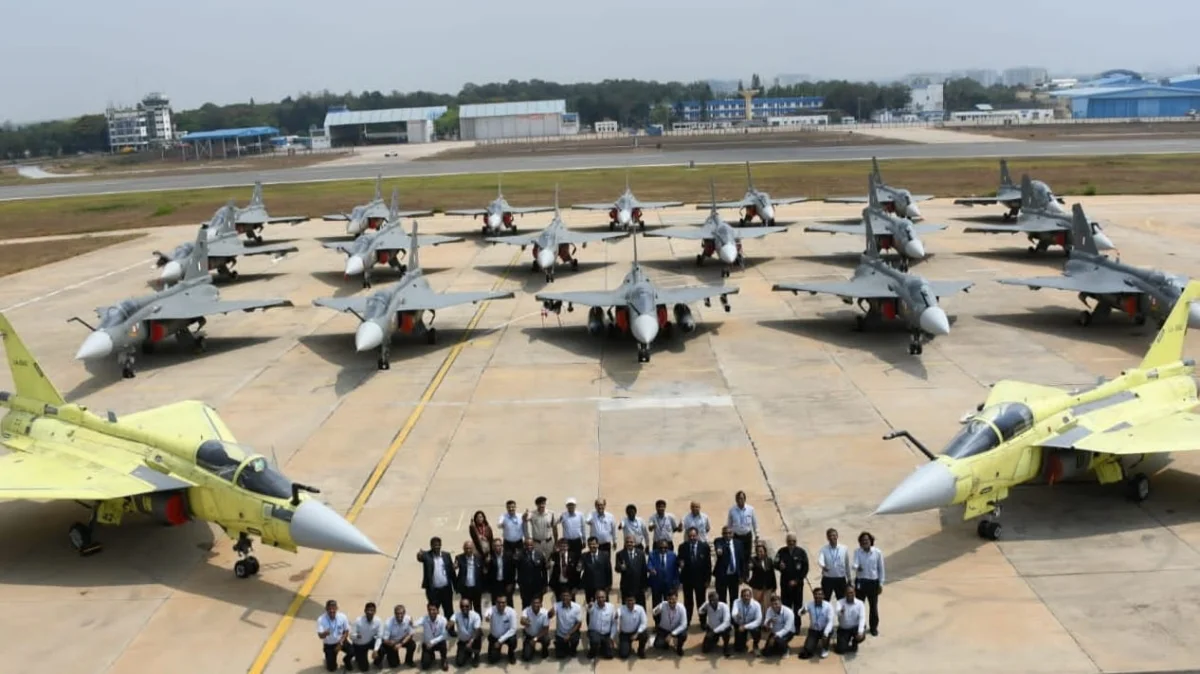
India's Defence Ministry set a delivery schedule of September 2027 through September 2033 for 97 new Tejas Mk1A fighter jets worth ₹62,370 crore ($7.5 billion), according to Defence Ministry. The second batch includes 68 single-seat fighters and 29 trainers, bringing the total Mk1A order to 180 aircraft. Yet the timeline marks another chapter in India's decade-long struggle to operationalize its homegrown combat jet, as Hindustan Aeronautics Limited (HAL) has yet to deliver a single Mk1A from an earlier 83-jet contract signed in 2021.
HAL is completing the original 40-aircraft Mk1 order nearly 10 years behind schedule, with the final two twin-seat trainers handed over this month. Engine shortages, software bugs, and weapons-validation delays have plagued the program, forcing HAL and the Indian Air Force to prioritize testing over speed. The new order does bring relief: HAL opened a third production line in Nashik this year, raising total capacity to 24 jets annually from eight.
GE Engines and the Supply-Chain Bottleneck
The Tejas program's core problem is the GE F404 engine. When HAL ordered 99 follow-on engines in 2021, GE had already shut its dedicated F404 production line in Massachusetts years earlier. GE Aerospace had to restart the dormant line and re-engage suppliers during pandemic-driven disruptions, creating a cascade of delays. By March 2025, GE Aerospace finally delivered the first fresh batch of engines after nearly 24 months of waiting.
As of August 2026, GE Aerospace shipped three more F404-IN20 engines to HAL. HAL Chairman Ravi K. said the company has received 10 engines total and confirmed 27 Mk1A airframes are complete. But he warned: "Maybe we are at 90–95%, but the last 5% is still to be fixed." That remaining 5% includes radar integration, missile clearances, and electronic-warfare systems—all critical for combat readiness.
New Indigenous Systems and Expanded Local Content
The second 97-jet batch features over 64% local content and incorporates 67 new domestic systems, a major push toward self-reliance. The jets will carry the DRDO-developed UTTAM AESA radar and the Swayam Raksha Kavach electronic-warfare suite, both built in India. Astra Microwave won a ₹2,205-crore order for 122 Active Antenna Array Units that feed the UTTAM radar, Economic Times reported.
The new order generates an estimated 11,750 domestic jobs annually over six years and supports over 105 local suppliers. India's push to indigenize fighter jets reflects vulnerability to foreign dependency: when GE shut its F404 line, the entire Tejas program stalled. Domestic radar and weapons systems reduce that risk but require rigorous testing. The IAF insists on full certification before operational deployment, delaying but ultimately strengthening the final product.
Weapons Validation and the Race Against Squadron Shortfall
The Indian Air Force operates roughly 29 fighter squadrons against a requirement of 42.5 squadrons—its lowest level in six decades, according to Defence Ministry statements. Each delayed Tejas delivery widens that gap. The Mk1A program faced a reported failure of the Astra Mk1 air-to-air missile during trials, prompting extra validation work. Later tests succeeded, but clearance of other beyond-visual-range and standoff weapons remains incomplete.
Defence Minister Rajnath Singh flagged the delays publicly, urging HAL to create "technologies that do not exist" rather than accepting half-finished solutions. The IAF and Hindustan Aeronautics Limited are expected to review the Mk1A program this month, with testing and certification taking priority over rushing jets into service. This cautious approach protects pilots and mission success but means India's fighter shortfall will persist for years.
The Path Forward: Production Ramp and Delivery Reality
HAL's Bengaluru and Nashik facilities are now equipped to produce 24 Tejas jets per year. If the September 2027 start date holds, delivering 97 jets over six years requires an average of 16 jets annually—well within capacity. However, HAL must first clear the backlog from the 83-jet 2021 contract. The first 10 Mk1A deliveries are promised by March 2027, a target that depends on GE supplying engines on schedule and software-integration work proceeding without major hitches.
The revised value of the original 40-aircraft order rose from ₹5,989 crore to ₹6,542 crore in March 2025 due to schedule extensions. Cost overruns and penalties on GE for late engines are now routine. Whether the new 97-jet timeline avoids further slippage hinges on steady engine arrivals, flawless avionics integration, and weapon-clearance campaigns running in parallel. India's ability to field a modern indigenous fighter depends on it.
Sentiment
Mostly PositiveNEGATIVENEUTRALPOSITIVE
Publishers
30
Articles
16
Reach
46
A
AnonymousAuthor