Physics Nobel for IceCube
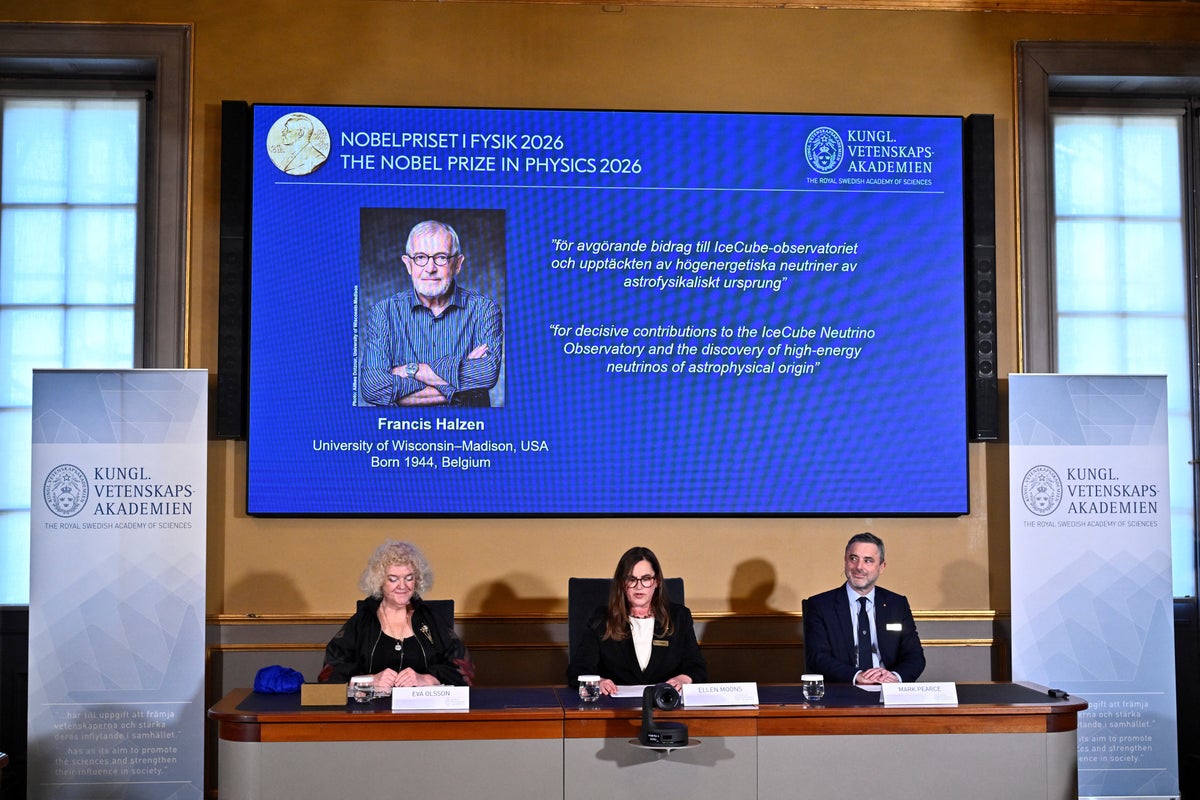
Francis Halzen Wins Physics Nobel for Pioneering Work With Antarctic IceCube Observatory
Anonymous
Key Points
1
Nobel Committee for Physics chair Mark Pearce said Halzen led an international team of researchers and engineers, adding: “His tenacity and scientific vision has paved the way for a new kind of astronomy.”
2
Neutrinos are especially difficult to detect because they carry no electric charge and interact very weakly with matter; vast numbers pass through Earth and human bodies without leaving a trace.
3
Halzen was born in Belgium, is 82, and is affiliated with the University of Wisconsin–Madison in the United States.
4
IceCube is equipped with thousands of light sensors, which help scientists determine where detected neutrinos originated.
Francis Halzen has won the 2026 Nobel Prize in Physics for building IceCube, a cosmic neutrino detector buried deep in Antarctic ice at the South Pole. NPR reports the 82-year-old Belgian-born physicist at the University of Wisconsin–Madison was honored for discovering high-energy neutrinos from astrophysical sources — opening an entirely new window onto the violent universe. According to The Independent, the Nobel Committee chair Mark Pearce said Halzen's "tenacity and scientific vision has paved the way for a new kind of astronomy."
IceCube represents a radical shift in how astronomers study the cosmos. Instead of looking at light or radio waves from distant explosions and black holes, the observatory detects ghostly particles called neutrinos that zip through the universe nearly unimpeded. NBC Miami notes the detector uses thousands of light sensors embedded in a cubic kilometer of ice to catch the rare flashes when neutrinos collide with matter.
Why Neutrinos Matter for Astronomy
Neutrinos are nearly impossible to catch. They carry no electric charge and barely interact with normal matter. Trillions of them pass through your body every second without leaving a trace. But when a massive star explodes or material falls into a black hole, it floods the universe with neutrinos. Detecting them lets scientists study cosmic violence in a way traditional telescopes simply cannot.
The Union Bulletin explains that IceCube's thousands of sensors can identify where neutrinos came from by timing how light spreads through the ice. This pinpointing ability transformed neutrinos from invisible noise into genuine astronomical messengers — opening what Pearce called "a new kind of astronomy."
From Belgium to the South Pole
Halzen was born in Belgium and spent his career pushing physics to its limits. Springfield News-Sun notes he led an international team of researchers and engineers across decades to design, build, and operate IceCube in one of Earth's most hostile environments. The South Pole location was no accident — the thick, pristine Antarctic ice creates a natural laboratory ideal for catching neutrinos.
A Detector That Changed Physics
IceCube began operations in 2011 and quickly proved the concept worked. Within years, it detected high-energy neutrinos arriving from beyond our solar system — confirming that the universe was flooded with these particles from violent astrophysical sources. Each detection felt like finding a message in a bottle from a distant cosmic explosion. The observatory now runs as a collaborative platform, with scientists worldwide analyzing its data to map the high-energy universe in real time.
Sentiment
Mostly PositiveNEGATIVENEUTRALPOSITIVE
Publishers
34
Articles
315
Reach
349
Topics
A
AnonymousAuthor


