Antarctic Ozone Expansion
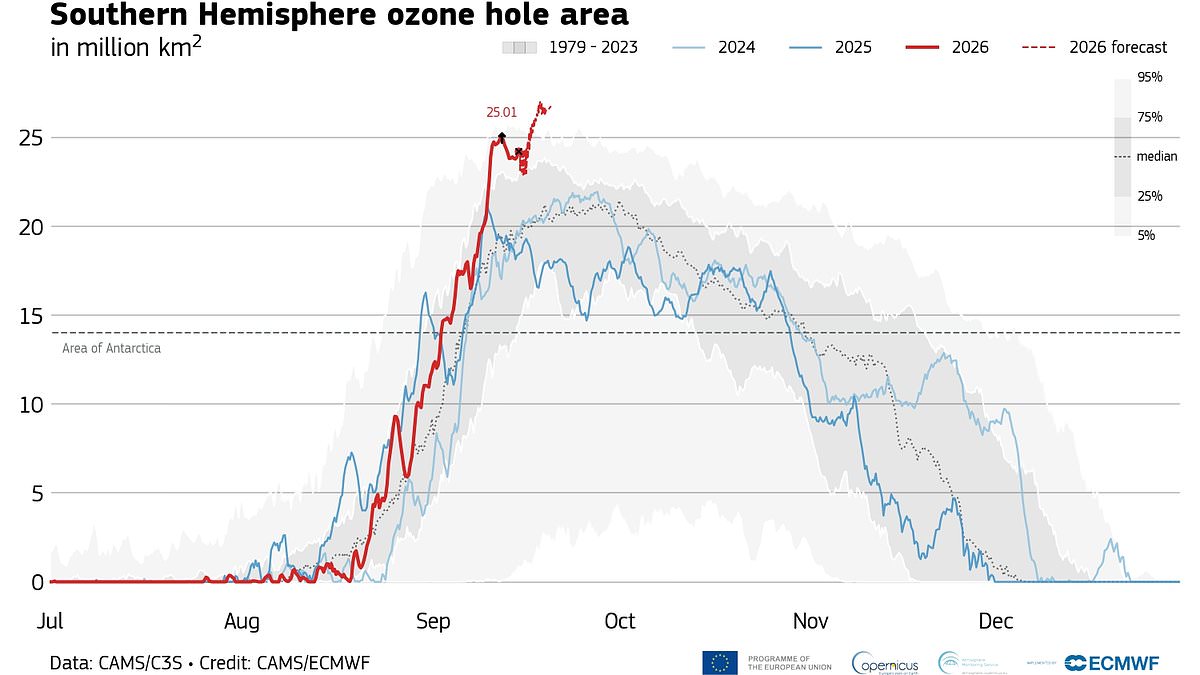
The Antarctic ozone hole has expanded sharply, reaching 25 million square kilometers in September.
Anonymous
Key Points
1
CAMS defines the ozone hole as the area south of 60°S where total-column ozone falls below 220 Dobson Units, rather than simply any region with reduced ozone.
2
The estimated 25 million-square-kilometre ozone hole on September 12 was larger than the entire Antarctic continent.
3
The largest Antarctic ozone-hole area recorded to date was 29.6 million square kilometres, measured on September 9, 2006.
4
CAMS Director Laurence Rouil said the findings highlight “the complicated interaction between human-made disturbances and natural factors” and the need to track the ozone layer’s long-term recovery.
5
The update was issued ahead of the United Nations’ International Day for the Preservation of the Ozone Layer on September 16; the ozone layer protects life by absorbing much of the Sun’s ultraviolet radiation, exposure to which is a major cause of skin cancer.
The Antarctic ozone hole swelled to 25 million square kilometers by September 12, 2026, roughly 5 million square kilometers above the typical size for early autumn. Copernicus Atmosphere Monitoring Service said a sudden temperature drop 20 kilometers above the South Pole triggered polar stratospheric clouds and accelerated ozone-destroying reactions when sunlight returned. The hole is now larger than the entire Antarctic continent.
Despite the unusually large area, the hole's minimum ozone concentration and total ozone deficit remained close to historical averages, scientists noted. CAMS warned the hole could expand further before reaching its seasonal peak. The finding comes ahead of the UN's International Day for the Preservation of the Ozone Layer on September 16.
How Temperature Swings Fueled Rapid Expansion
August started typically, with the ozone hole reaching 15 million square kilometers by month's end. Then stratospheric temperatures plummeted near the South Pole in early September. Streamline Feed reported this cold snap created ideal conditions for polar stratospheric clouds to form. These clouds host chemical reactions that destroy ozone when the sun's rays return at spring onset.
The rapid acceleration caught scientists' attention because the hole grew 10 million square kilometers in just two weeks—much faster than the gradual August pace. Temperature swings in the stratosphere directly control whether ozone-depleting chemicals activate, making year-to-year variation unavoidable.
Why Size Alone Doesn't Show Ozone Loss Severity
The 25-million-square-kilometer hole sounds alarming, but CAMS Director Laurence Rouil emphasized that area measurements don't capture the full picture. The ozone hole is defined specifically: any region south of 60°S where ozone concentration drops below 220 Dobson Units. A larger hole doesn't always mean deeper depletion.
In 2026, the minimum ozone concentration and the total ozone mass deficit both stayed near historical averages despite the expanded area. This disconnect shows that weather patterns shape the hole's geometry, while long-term chemical trends determine actual ozone loss. Scientists stressed the difference matters for understanding global ozone recovery.
Historical Record Still Held by 2006's Massive Hole
The current 25-million-square-kilometer hole ranks among the largest ever observed, but it falls short of the all-time peak. On September 9, 2006, the ozone hole reached 29.6 million square kilometers—about 4.6 million square kilometers larger than this year's maximum. That 2006 event occurred during a particularly cold Antarctic spring.
Recent years have brought smaller, shorter-lived ozone holes compared to the 1990s and 2000s, Copernicus noted. Scientists view this trend as a sign the ozone layer is recovering thanks to the 1987 Montreal Protocol, which phased out ozone-damaging chlorofluorocarbons and similar chemicals. Natural variability will cause year-to-year swings, but the long-term trajectory points upward.
Why the Ozone Layer Matters for Human Health
The ozone layer sits about 20 kilometers above Earth and absorbs much of the sun's ultraviolet radiation. Without this shield, UV exposure on the ground increases sharply, raising rates of skin cancer, cataracts, and immune suppression. The ozone hole over Antarctica doesn't directly affect populated regions, but it does weaken global ozone coverage.
The UN designated September 16 as the International Day for the Preservation of the Ozone Layer to mark the Montreal Protocol's signing in 1987. That treaty banned chemicals driving ozone destruction and is considered one of the most successful environmental accords. Rouil highlighted that tracking the ozone layer's recovery requires understanding how human-made chemicals interact with natural atmospheric processes.
Sentiment
Mostly PositiveNEGATIVENEUTRALPOSITIVE
Publishers
11
Articles
4
Reach
15
Topics
A
AnonymousAuthor


