South Korea Rules Out Joining Iran War
South Korea Rules Out Joining Iran War
Anonymous
Key Points
1
President Lee’s refusal came after President Trump publicly criticized Seoul for not helping defend the Strait of Hormuz while U.S. troops remain stationed on the Korean Peninsula to deter North Korea.
2
The South Korean naval force under consideration is a destroyer and support ships already deployed off Somalia for antipiracy operations, rather than a new combat force sent to the Middle East.
3
Trump said North Korea now possesses 57 “very powerful” nuclear weapons, while South Korean officials estimate Pyongyang has roughly 80 to 120 nuclear warheads.
4
Lee said renewed U.S.-North Korea talks would be easier to restart than inter-Korean dialogue; relations between Seoul and Pyongyang deteriorated after the February 2019 collapse of Trump-Kim negotiations, and North Korea has not clearly responded to Trump’s latest outreach.
5
Chinese Foreign Minister Wang Yi urged Iran to return to a June memorandum of understanding with the United States, while Iranian Foreign Minister Abbas Araghchi said Tehran still considered the memorandum valid and wanted to return to a diplomatic settlement.
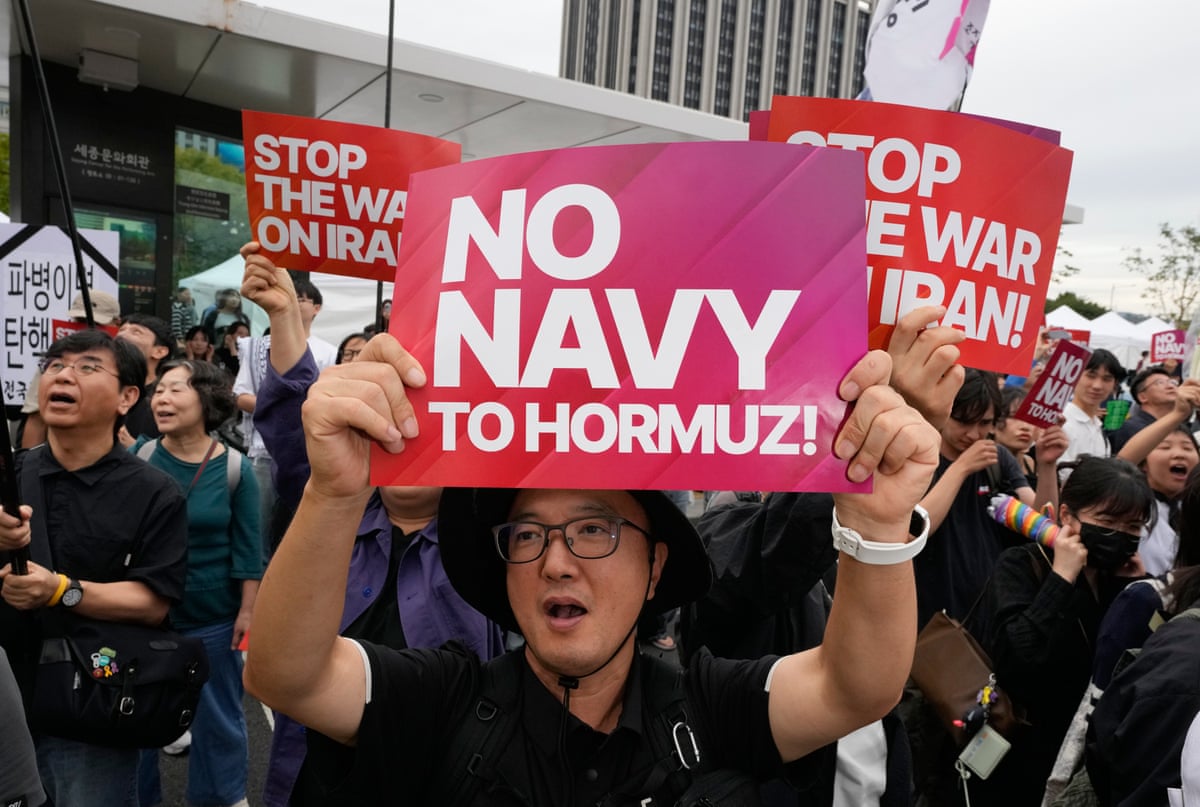
South Korean President Lee Jae Myung firmly rejected deploying troops to support the U.S. war against Iran, defying public pressure from President Trump. The Guardian reported that Lee said South Korea would instead expand naval operations only to protect its own ships, oil shipments, and citizens near the Red Sea and Strait of Hormuz—a distinction aimed at avoiding direct involvement in the conflict.
The decision comes as Trump has criticized Seoul for not helping defend the Strait while 28,500 U.S. troops remain stationed on the Korean Peninsula to deter North Korea. Al Jazeera noted that Lee also confirmed Trump wants to restart talks with North Korea, with Seoul pursuing preliminary coordination—though Pyongyang has not clearly responded to the overture.
Seoul's Narrow Line on Hormuz Protection
South Korea's naval response focuses on ships already deployed, not new forces sent to the Middle East. TRT World reported that Lee is considering using a destroyer and support vessels currently stationed off Somalia for antipiracy operations. This move allows Seoul to safeguard its commercial interests without appearing to join the Iran war—a careful balance between security and diplomacy.
Trump's Nuclear Arsenal Claims Differ From Seoul's Estimates
Trump stated that North Korea now possesses 57 "very powerful" nuclear weapons. South Korean officials, however, estimate Pyongyang has roughly 80 to 120 nuclear warheads—a significant gap that reflects uncertainty about the regime's true weapons stockpile. These figures highlight the stakes as both Washington and Seoul explore renewed dialogue with Kim Jong Un.
U.S.-North Korea Talks May Move Faster Than Seoul-Pyongyang Ties
Lee said reopening U.S.-North Korea dialogue would be easier than restoring inter-Korean relations. Al Jazeera reported that ties between Seoul and Pyongyang deteriorated sharply after Trump-Kim negotiations collapsed in February 2019. Trump has expressed hope to meet Kim Jong Un later this year, though North Korea has not clearly signaled its response to his latest overture.
China Pushes Iran and U.S. Toward Diplomacy
Chinese Foreign Minister Wang Yi urged Iran to return to a June memorandum of understanding with the United States. Iranian Foreign Minister Abbas Araghchi said Tehran still viewed the agreement as valid and wanted a diplomatic path forward. China is pressing both sides to exercise restraint, resume substantive talks, and take steps to reopen the Strait of Hormuz—critical for global shipping and energy flows.
Sentiment
Mostly PositiveNEGATIVENEUTRALPOSITIVE
Publishers
70
Articles
111
Reach
181
A
AnonymousAuthor


