Commercial Radar Satellites Launched
China Successfully Launches Four Commercial Radar Satellites Aboard a Long March Rocket
Anonymous
Key Points
1
The Long March-2D is a two-stage liquid-fueled rocket with a payload capacity of 1.3 tonnes to a 700-kilometer sun-synchronous orbit.
2
The satellites are owned by Zhuzhou Space Interstellar Satellite Technology Co., Ltd., a commercial company founded in 2022 to operate remote-sensing constellations.
3
The PIESAT-2 satellites are primarily intended for high-precision imaging, according to CGTN’s account of the mission.
4
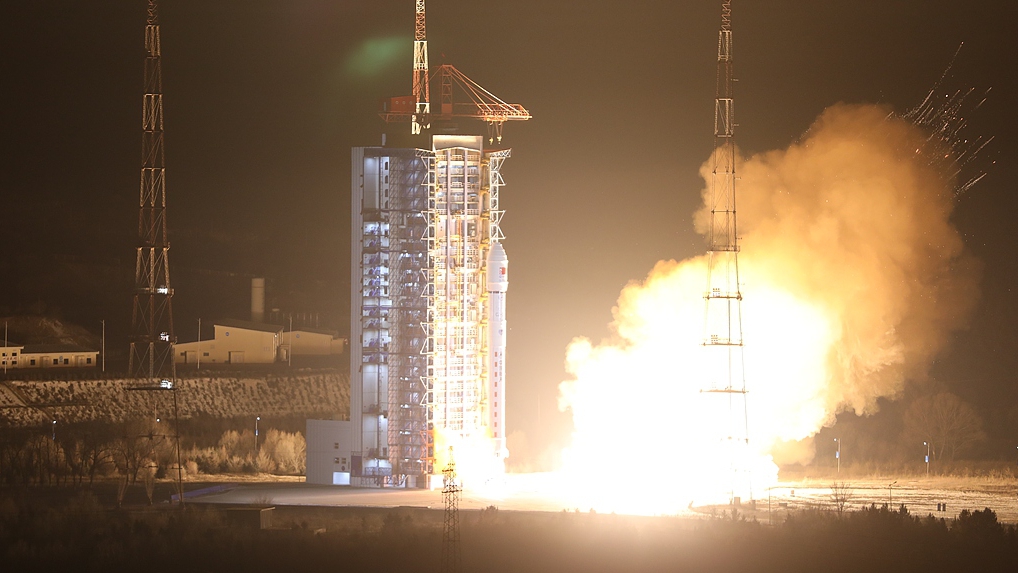
The launch took place at the Taiyuan Satellite Launch Center in northern China’s Shanxi Province.
China launched four commercial radar satellites on Saturday evening from the Taiyuan Satellite Launch Center in Shanxi Province. A Long March-2D rocket carried the PIESAT-2 13-16 satellites into orbit at 6:50 p.m. Beijing time, marking the 668th flight of China's Long March rocket series Ratopati.
The satellites use synthetic-aperture radar and high-resolution imaging to gather data from space. Built by Zhuzhou Space Interstellar Satellite Technology, a commercial firm founded in 2022, they feature onboard processing that analyzes remote-sensing information in real time without waiting for downloads.
Rocket Powers Four Remote-Sensing Craft Into Orbit
The Long March-2D is a two-stage liquid-fueled rocket capable of carrying 1.3 tonnes to a sun-synchronous orbit 700 kilometers above Earth. Saturday's mission successfully placed all four PIESAT-2 satellites into their preset orbits, advancing China's commercial space infrastructure.
Commercial Company Operates New Imaging Constellation
Zhuzhou Space Interstellar Satellite Technology owns and operates the four new satellites. The company was founded in 2022 to build and manage remote-sensing constellations for China's growing commercial space sector. The PIESAT-2 constellation specializes in high-precision imaging for civilian and commercial applications.
Smart Onboard Processing Reduces Data Download Delays
Unlike older satellites that must transmit raw data to ground stations, the PIESAT-2 satellites process information in real time while orbiting. Onboard intelligent systems analyze radar and imaging payloads instantly. This capability lets users receive finished analyses faster than traditional methods, cutting operational delays for time-sensitive applications.
China Expands Foothold in Global Commercial Space
Saturday's launch reflects China's push into the commercial remote-sensing market. Private companies like Zhuzhou Space Interstellar now compete alongside state-owned firms to build satellite networks. The PIESAT-2 mission shows how Chinese commercial space is scaling up constellation capabilities and smart satellite technology to serve global demand for high-resolution Earth observation.
Sentiment
Mostly PositiveNEGATIVENEUTRALPOSITIVE
Publishers
12
Articles
18
Reach
30
A
AnonymousAuthor


