Nepal Flood Crisis
Nepal flood survivors cross swollen river by zip line amid ongoing disaster crisis
Anonymous
Key Points
1
Suresh Kumar Karanjit, a relief-center resident in Devighat, said his heart medication was not available in the camp, and he had to sell a carton of noodles to raise 400 rupees to buy his regular medicine.
2
Rescue operations are focusing on tunnels at hydroelectric projects, with about 900 workers missing and international teams from India, China and the United States involved in efforts to reach those trapped (including at the Trishuli-3A tunnel).
3
Nepal’s disaster agency reported 1,252 people killed and more than 4,200 missing, while China reported 21 dead and 541 missing on the Tibet side of the border.
4
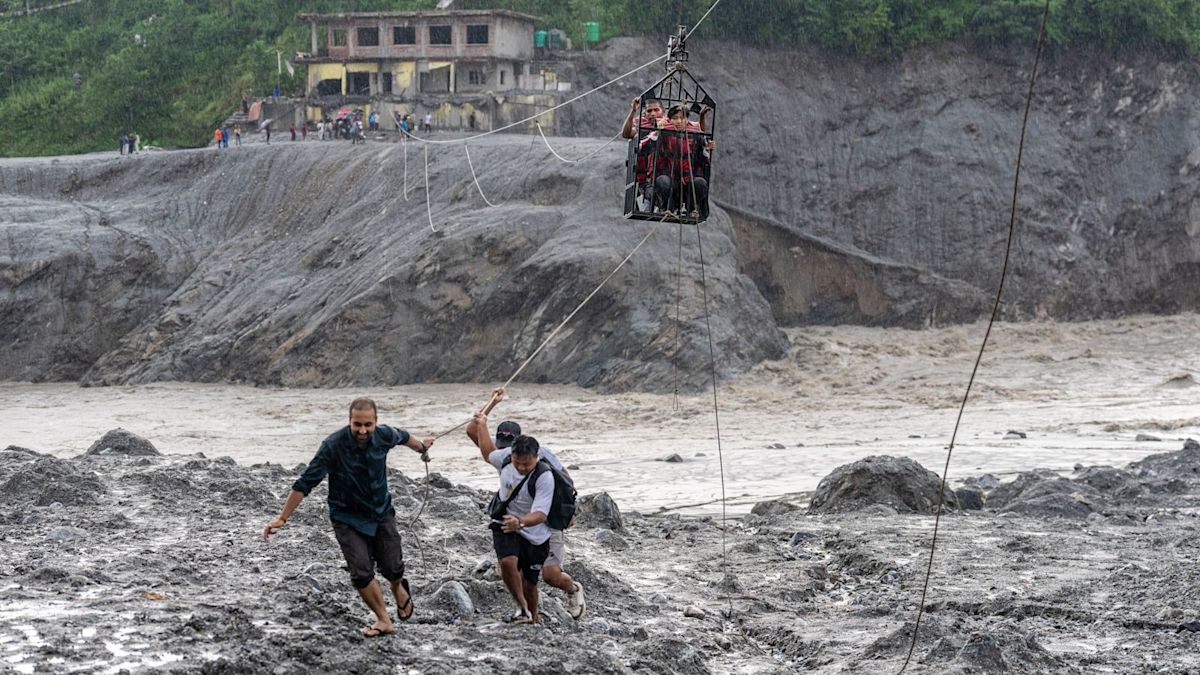
In Bidur town, residents used a temporary zip line across the swollen Trishuli River as army personnel assisted people onto the crossing, providing a makeshift lifeline amid destroyed bridges and roads.
Survivors of last week's catastrophic floods in Nepal are crossing a swollen river by zip line to reach aid and supplies. Al Jazeera reported that residents in Bidur town use the makeshift line across the Trishuli River, with army personnel guiding people onto the crossing. Bridges have been destroyed and roads washed away, making the zip line a critical lifeline in the disaster zone.
The disaster has killed at least 1,252 people and left over 4,200 missing across Nepal, Yahoo News reported. Rescue teams are now focused on hydroelectric tunnels where about 900 workers remain trapped. Meanwhile, survivors in relief camps face severe shortages of medicines and cash, adding to the crisis facing thousands of displaced families.
Makeshift Zip Line Becomes Emergency Crossing
With the Trishuli River swollen from the floods, authorities set up a temporary zip line to connect residents separated by the raging water. Al Jazeera showed how army personnel assisted people onto the crossing in Bidur town, one of several areas cut off by destroyed infrastructure. The zip line allows residents to move between riverbanks to access aid, food, and supplies distributed in relief camps.
The crossing highlights how quickly disaster forces communities to innovate. Roads remain impassable and bridges lie destroyed across Nepal's landscape. NBC Boston reported that this improvised solution offers residents their only path to reach help and reconnect with separated families.
Medicine Shortages Deepen Hardship in Relief Camps
Survivors in relief camps face a critical problem: essential medicines are not available. Yahoo News reported that Suresh Kumar Karanjit, a resident in Devighat camp, needed heart medication but could not find it. He was forced to sell a carton of noodles to raise 400 rupees (about $3) to buy his regular medicine from outside the camp.
The shortage extends beyond one person. Authorities have distributed food and basic supplies to thousands displaced by the floods, but chronic medicines remain unavailable. Yahoo News noted that this gap in medical support worsens conditions for elderly residents and those with ongoing health conditions who have already lost homes and livelihoods.
Rescue Efforts Expand to Hydroelectric Tunnels
The search for survivors has widened to include tunnels at hydroelectric power projects, where hundreds remain trapped. NBC San Diego reported that about 900 workers are missing at these sites, including at the Trishuli-3A tunnel. International rescue teams from India, China, and the United States are now assisting Nepal's efforts to reach those stranded underground.
The death toll reflects the scale of the disaster. Nepal's disaster agency reported 1,252 deaths with over 4,200 people missing. NBC Philadelphia noted that China reported 21 deaths and 541 people missing on the Tibet side of the border, showing the floods' impact extends across national boundaries.
Sentiment
Mostly NegativeNEGATIVENEUTRALPOSITIVE
Publishers
14
Articles
146
Reach
160
Topics
A
AnonymousAuthor


