Sarnath: World Heritage
India's Sarnath, Sacred Buddhist Site, Joins UNESCO World Heritage List After 28 Years
Anonymous
Key Points
1
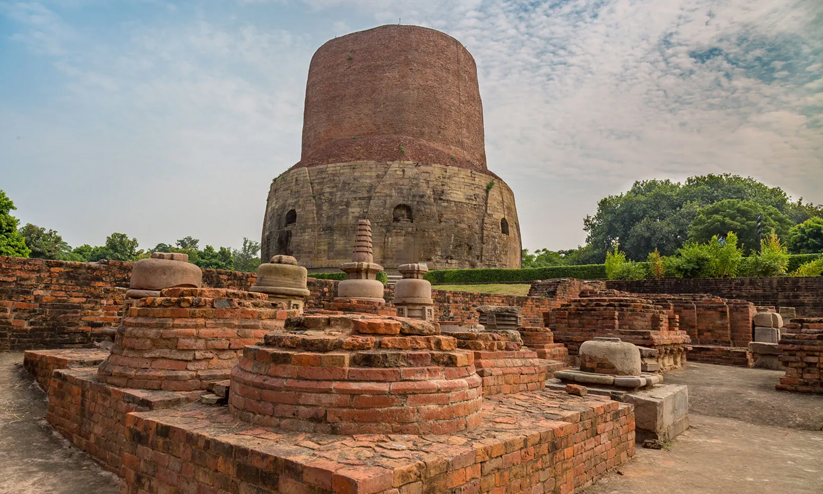
Chaukhandi Stupa is included along with the Archaeological Remains of Sarnath in the UNESCO inscription, and both are located about 626 metres apart. The Chaukhandi Stupa commemorates Buddha’s meeting with his five companions after enlightenment, while the archaeological complex includes the Dhamek Stupa, Dharmarajika Stupa, Ashokan Pillar and extensive monastic remains.
2
The inscription also features the Ashokan Pillar at Sarnath, topped with the lion capital, a symbol that was later adopted as India’s national emblem.
3
Ashoka’s era at Sarnath includes the Dharmarajika Stupa, a 30-meter-high monument he erected, along with other works such as the Dhamek Stupa and associated Ashokan monuments.
4
Sarnath is noted as the site where Buddha delivered the first sermon and founded the first Sangha, with historical accounts describing the early Sangha of 60 monks (Yasa and 54 companions) and the turning of the wheel of Dharma (Dharmachakra Pravartana).
5
India submitted a dossier titled 'Ancient Buddhist Site, Sarnath' to UNESCO for the 2025-26 nomination cycle, a development confirmed by Union Culture Minister Gajendra Singh Shekhawat in August 2025.
Sarnath, the ancient Buddhist site in Uttar Pradesh where the Buddha delivered his first sermon, has been inscribed on UNESCO's World Heritage List, becoming India's 45th site to earn the honor. The decision was made at the 48th Session of the World Heritage Committee in Busan, South Korea, according to Kashmir Despatch.
The recognition ends a 28-year wait. Sarnath was placed on UNESCO's Tentative List back in 1998. India submitted a formal dossier titled 'Ancient Buddhist Site, Sarnath' for the 2025-26 nomination cycle, confirmed by Union Culture Minister Gajendra Singh Shekhawat, Madhyamam Online reported.
Why Sarnath Matters to Buddhism's Entire History
Sarnath sits about 10 kilometers from Varanasi. It is the place where the Buddha turned the Wheel of Dharma — the Dharmachakra Pravartana — delivering his first teaching after reaching enlightenment. That moment founded the first Buddhist Sangha, according to NDTV Profit.
The early Sangha grew fast. Historical accounts describe a community of 60 monks, including Yasa and 54 companions. The site also marks where the Buddha first met five disciples after his enlightenment, an event commemorated by the Chaukhandi Stupa. The stupa and the main archaeological complex sit just 626 meters apart, Kashmir Despatch noted.
Stupas, Pillars, and the Lion Capital India Still Uses
The inscribed site includes several major monuments. The Dhamek Stupa and the Dharmarajika Stupa are its most iconic structures. Emperor Ashoka built the Dharmarajika Stupa — a 30-meter-high monument — during his reign. He also erected an Ashokan Pillar at the site, Madhyamam Online reported.
The top of that pillar carries the lion capital. India later adopted it as its national emblem. Extensive monastic remains spread across the complex alongside these structures, making Sarnath one of the most layered archaeological sites in South Asia, according to The Hour.
Modi, VP Radhakrishnan Celebrate India's 45th World Heritage Site
Indian leaders were quick to mark the occasion. Vice President CP Radhakrishnan called it "a moment of great pride," saying the inscription reflects India's civilizational and spiritual heritage. He described the recognition as an open invitation for global visitors to connect with Buddhist teachings, India's News reported.
Prime Minister Narendra Modi also welcomed the honor. Officials framed Sarnath not just as a historical site but as a living center of Buddhism's global legacy. India now holds 45 UNESCO World Heritage Sites, placing it among the top-ranked countries on the list.
Other Sites Inscribed Alongside Sarnath at Busan Session
The Busan session added several other sites to the World Heritage List alongside Sarnath. Thailand's Wat Phra Mahathat Woramahawihan temple made the list. So did the Okefenokee Swamp in the United States, historic towns in Comoros, and South Korea's tidal flats, according to NDTV Profit.
China's porcelain industry sites also received recognition at the same session. The round of inscriptions shows UNESCO's broad sweep — covering religious monuments, wetlands, and industrial heritage across Asia, the Americas, and Africa in a single meeting, Madhyamam Online noted.
Sentiment
Mostly PositiveNEGATIVENEUTRALPOSITIVE
Publishers
21
Articles
47
Reach
68
A
AnonymousAuthor


