China Sets 24% World-Record Large Perovskite Module
China Sets 24% World-Record Large Perovskite Module
Anonymous
Key Points
1
In the Chinese large-area module development, the 810 cm² module achieved an MPPT output of 19.4 W with an open-circuit voltage of 53.46 V, a short-circuit current of 0.436 A, and a fill factor of 83.40%, highlighting strong scaled-performance metrics beyond the efficiency figure.
2
The Korean perovskite-CIGS tandem efficiency record (26.7%) was demonstrated on a laboratory cell with an area under 1 cm², confirmed by Fraunhofer ISE, achieved with a protective interface layer and an improved transparent top electrode to reduce interfacial losses. Scaling this performance to full-size panels remains a principal challenge.
3
Japanese researchers report that introducing 2-aminobenzothiazole (2-ABZ) into tin-based perovskite cells provides multifunctional passivation, stabilizing crystallization, suppressing trap formation and tin oxidation, and improving interface energy alignment. The result was 9.07% efficiency with 100-day retention at 84.94% of initial value, versus 48.95% for untreated devices.
4
An inverted perovskite device reached 24.6% efficiency using a two-step organic molecule treatment: initially PDAI fills grain-boundary voids to stabilize charge transport, followed by 4TF binding to exposed lead on the surface, producing complementary passivation effects not seen with single-molecule treatments.
5
CPMAC is introduced as an ionic-salt electron shuttle formed by reacting N-methylglycine and related forms to produce a CPMA-based cation with chloride, which bonds ionically to the perovskite surface and strengthens the electron-transport layer interface. DFT suggests CH-NH+ heads fill FA vacancies, enhancing interfacial packing and conductivity, and enabling improved electron transport in inverted PSCs and minimodules.
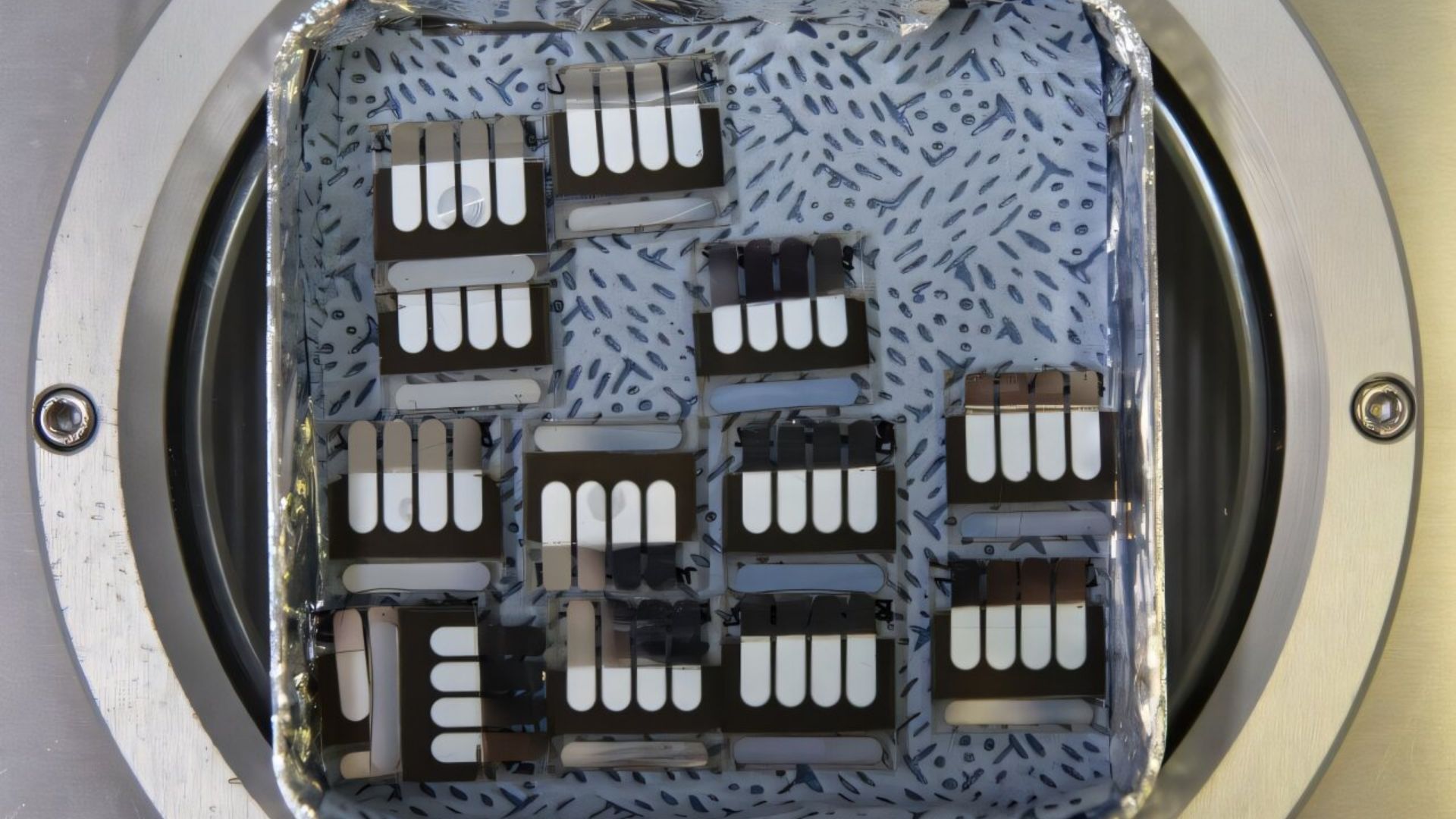
China's Nanjing University and Renshine Solar have set a world record for large perovskite solar modules, achieving 24.0% efficiency on an 810-square-centimeter panel Yahoo Tech. The breakthrough uses lead carboxylate passivators to improve stability and charge transport, delivering an output of 19.4 watts with an open-circuit voltage of 53.46 volts. Meanwhile, researchers across Asia are racing to scale perovskite technology — from lead-free alternatives to hybrid tandem cells reaching 26.7% efficiency in the lab.
Perovskite solar cells promise cheaper, lighter alternatives to silicon. But moving from lab breakthroughs to full-size, reliable panels remains the industry's biggest challenge. Recent advances tackle moisture resistance, thermal stability, and interfacial defects — each a key hurdle on the path to mass production.
China's 810-Square-Centimeter Module Hits 24% Efficiency
The Chinese team achieved a certified 24.0% efficiency rating on a 125.6-square-inch module, far larger than typical lab cells Yahoo Tech. The module delivered 19.4 watts of power with an 83.40% fill factor — a measure of how well the cell converts available current and voltage into usable electricity. These scaled-performance metrics show the technology works beyond the efficiency number alone.
Lead carboxylate passivators were the key innovation Yahoo Tech. These chemicals heal defects on the perovskite surface and within its crystal structure, improving both moisture and heat resistance. The approach sidesteps the efficiency-versus-stability trade-off that has long plagued perovskite research.
South Korea Achieves 26.7% Lab-Scale Tandem Record
Researchers at the Korea Institute of Energy Research stacked perovskite and CIGS (copper indium gallium selenide) layers to reach 26.7% efficiency Zamin.uz. The achievement, certified by Fraunhofer ISE, proves that hybrid tandem architectures can outperform single-layer designs. However, the record applies only to tiny lab cells under 1 square centimeter.
Scaling tandem cells to full-size panels is the next frontier Zamin.uz. The researchers used a protective interface layer and improved transparent top electrode to cut interfacial losses — the hidden energy wasted when light crosses from one material layer to another. Moving from a lab sample to a rooftop panel requires solving manufacturing, uniformity, and durability challenges.
Japan Develops Lead-Free Perovskites With 100-Day Stability
Japanese scientists replaced toxic lead with tin in their perovskite formulation, then added 2-aminobenzothiazole (2-ABZ) as a multifunctional passivator. The result: 9.07% efficiency with 84.94% of that output retained after 100 days of testing. Untreated tin perovskites lost 51.05% of their efficiency over the same period — a dramatic difference.
The 2-ABZ molecule works on multiple fronts Knowridge. It stabilizes crystal growth, suppresses trap formation inside the material, prevents tin oxidation, and aligns energy levels at the interface. This multi-layered defense signals that lead-free perovskites can become viable for commercial use — solving the toxicity concern that haunts the field.
Dual-Molecule Treatment Pushes Inverted Cells to 24.6%
Scientists from the Korea Institute of Energy Research developed a two-step chemical treatment that seals microscopic defects in perovskite cells Interesting Engineering. The first molecule, PDAI, fills grain-boundary voids and stabilizes charge transport. The second, 4TF, binds to exposed lead atoms on the surface, providing complementary passivation effects neither molecule achieves alone.
This inverted-architecture approach reached 24.6% efficiency Interesting Engineering — comparable to the Chinese record but using a different perovskite orientation. The dual-molecule strategy outperformed single-molecule treatments, showing that addressing both interior and surface defects is critical. This finding opens new avenues for pushing efficiency higher while maintaining stability.
Sentiment
Mostly PositiveNEGATIVENEUTRALPOSITIVE
Publishers
13
Articles
5
Reach
18
A
AnonymousAuthor


