Ceuta Border Crisis
Spain Deploys Troops as Thousands of Migrants Breach Ceuta Border from Morocco.
Anonymous
Key Points
1
Around 60,000 migrants crossed into Ceuta in the previous 24 hours, with roughly 37,500 already returned to Morocco by local media reports.
2
EU-wide reaction included condemnation from leaders and officials, with Ursula von der Leyen calling the Ceuta scenes 'unacceptable' and authorities noting there was no onward travel to the European mainland from Ceuta; Italy also urged that Spain be suspended from the Schengen area.
3
Ceuta’s population is about 83,000, highlighting how the mass influx strained city services and humanitarian responders far beyond what the enclave’s size would normally handle.
4
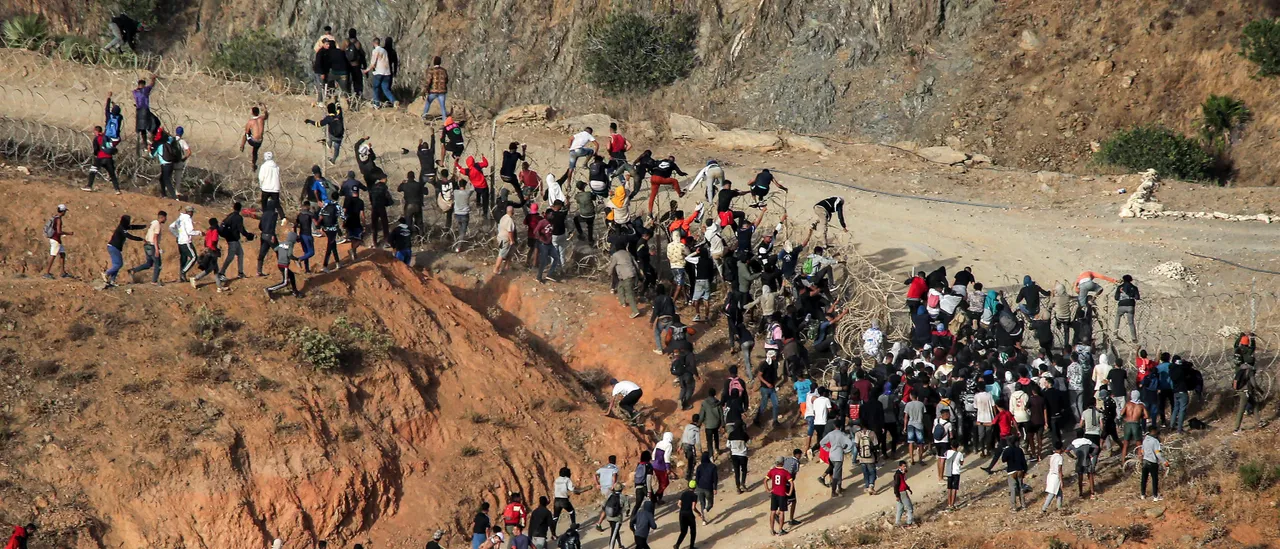
Crossings included migrants swimming around the Tarajal breakwater near the main border crossing, while security forces—including the army, divers, drones and boats—were deployed to restore order in Ceuta.
An estimated 60,000 migrants crossed from Morocco into Spain's tiny North African enclave of Ceuta in a single 24-hour window on July 30–31, 2026, according to CTV News and CBS News. The surge — equivalent to roughly 70% of Ceuta's 83,000 residents — overwhelmed shelters, flooded city parks with arrivals, and triggered a full military deployment.
Spain deployed army units, armored vehicles, divers, drones, and boats to restore order. The confirmed death toll ranged from 34 to 57, with many migrants drowning while swimming around the Tarajal breakwater. By late Friday, more than 48,300 migrants had returned to Morocco — at a reported rate of 150 people per minute — while thousands more remained stranded in Ceuta.
How 60,000 People Crossed in One Day
The crossings began Thursday morning, July 30. Migrants waded or swam around the Tarajal and Benzú breakwaters from the nearby Moroccan towns of Fnideq and Belyounech. By evening, clashes erupted on the Moroccan side of the border. Demonstrators set a bus and seven cars on fire. Ceuta's regional government declared the situation "absolute chaos" and asked Madrid to declare a national emergency.
The immediate trigger was a June 29 Spanish Supreme Court ruling. The court said migrants intercepted at sea must get full legal processing — not quick returns. Human traffickers spread word on social media that the sea borders were effectively "open." Spanish Prime Minister Pedro Sánchez called the surge "an attack, a violation of Spain's territorial integrity" and blamed "human trafficking mafias" for exploiting the ruling to deceive vulnerable people.
Military Deployed as Shelters Buckle Under Pressure
Spain's Interior Ministry sent army personnel, armored vehicles, police reinforcements, and naval divers to secure Ceuta's perimeter on Friday, July 31. Prime Minister Sánchez and Interior Minister Fernando Grande-Marlaska traveled to Ceuta to inspect the Tarajal crossing in person. A civil guard representative described a "serious humanitarian crisis" where the border "totally collapsed," leaving thousands — including unaccompanied children — sleeping in parks and on sidewalks.
Spain and Morocco quickly struck a bilateral deal to speed up repatriations. Migrants returned at a rate of 150 per minute, according to Spain's Interior Ministry. To close the legal loophole that triggered the crisis, Sánchez also announced plans to place a line of physical buoys near the Tarajal breakwater. The barrier would legally redefine the border line, allowing sea-interception rejections to resume.
Italy Suspends Schengen Travel as EU Divides Sharply
Italy responded by formally suspending its Schengen free-travel agreement with Spain, closing its air and maritime borders. French authorities activated border checks along the Pyrenees. European Commission President Ursula von der Leyen said the scenes in Ceuta were "unacceptable" and demanded swift returns, while Italian Prime Minister Giorgia Meloni called the breach "a genuine threat to the security of Europe's borders," according to CP24.
Legal experts pushed back on Italy's framing. Under EU law, no member state can expel another from the Schengen zone. Countries may temporarily reintroduce their own border controls — which Italy did — but a full suspension of Spain's Schengen membership is legally impossible. Austria and Finland also criticized Spain's migration policies, while Spain's Foreign Ministry accused Italy of "political demagoguery."
A Crisis That Echoes 2021 but Dwarfs It in Scale
The 2026 breach recalled a May 2021 incident when Morocco relaxed border controls during a diplomatic row, letting 8,000 to 10,000 migrants cross in two days. That crisis ended after Spain recognized Moroccan sovereignty over Western Sahara in 2022, leading to a migration deal in 2023. The July 2026 event was six times larger and arrived with no diplomatic warning, according to WNG.
Critics at home also targeted Sánchez's plan to grant legal residency to roughly 500,000 undocumented migrants already living in Spain — a policy opponents called a "pull factor." Far-right Vox leader Santiago Abascal accused Sánchez of "provoking an invasion." Human rights groups, meanwhile, framed the mass crossing as a tragedy driven by poverty and lack of jobs in northern Morocco, not political manipulation.
Sentiment
Mostly NegativeNEGATIVENEUTRALPOSITIVE
Publishers
30
Articles
104
Reach
134
A
AnonymousAuthor


