Ceuta Border Crisis
Spain Deploys Floating Barrier as Ceuta Migrant Crisis Eases; EU Seeks Coordinated Border Response
Anonymous
Key Points
1
A police union said the floating barrier alone is not enough to secure Ceuta and urged Madrid to deploy additional resources and a broader border-control strategy.
2
The barrier details include a 500-meter-long pneumatic installation on the Tarajal breakwater, standing 30 to 70 centimeters above water and extending up to about one meter below the surface, reinforced by an outer line of anchored naval buoys and a channel left open for Civil Guard patrols.
3
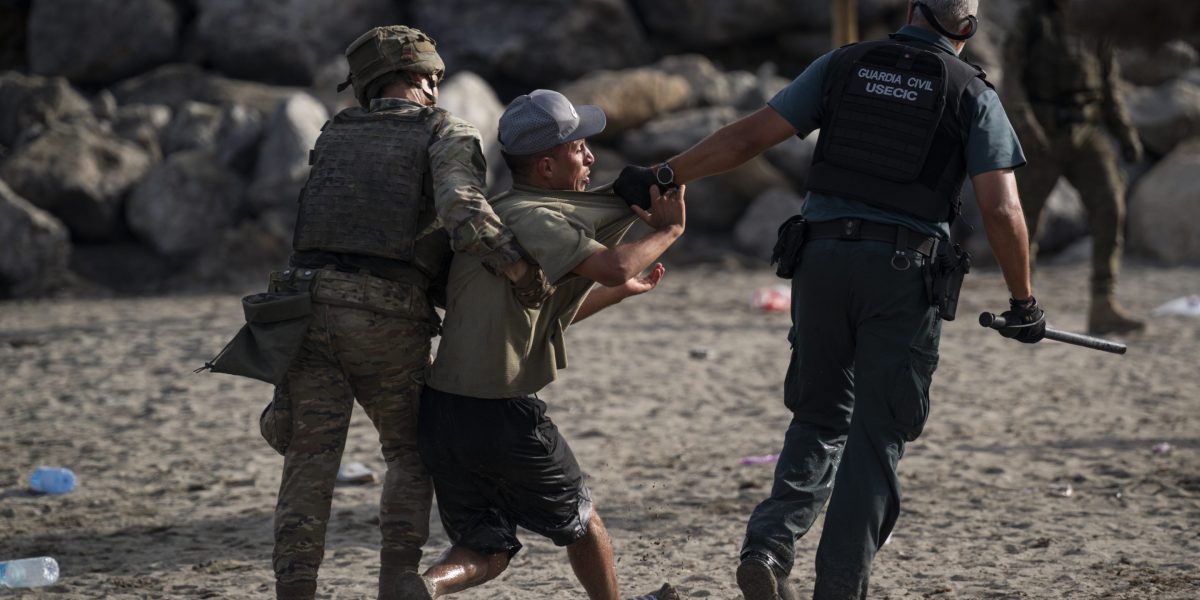
Some migrants who reached Ceuta swam to Tarajal beach and were escorted across by soldiers, illustrating ongoing humanitarian handling and a rapid security response as people were brought back toward the border.
4
Italy suspended Schengen arrangements with Spain for one month amid the Ceuta crisis, reflecting how the event triggered ripples in European border policies beyond Spain.
5
Hundreds of migrants voluntarily crossed back into Morocco on Saturday, underscoring a substantial reverse flow even after the surge at Ceuta.
Spain installed a 500-meter floating barrier along Ceuta's Tarajal breakwater on Saturday after an estimated 50,000 to 60,000 migrants crossed from Morocco in 48 hours — the largest border surge in the enclave's history. At least 67 people died from drownings and stampedes, according to Fortune and CTV News.
By Friday, Spain's Interior Ministry reported that more than 48,000 migrants had already returned to Morocco voluntarily. Crossings slowed to near-zero by Saturday morning, but questions about long-term border security and EU cooperation remain unanswered.
How a Court Ruling Sparked a 60,000-Person Surge
The crisis has legal roots. On July 8, Spain's Supreme Court published a ruling that said migrants who swim into Ceuta cannot be immediately expelled — because there is no physical barrier in the water. Human smuggling networks twisted that ruling on TikTok and messaging apps, falsely telling people that swimming in guaranteed safe passage to mainland Spain.
Ceuta President Juan Jesús Vivas called it an "absolute humanitarian and social emergency." The influx — equal to roughly 75% of Ceuta's 83,000-person population — overwhelmed hospitals, shelters, and the Civil Guard. Spain deployed 3,000 soldiers to help manage the chaos, according to Fortune.
Spain's Floating Barrier: What It Does and Why
At 7:50 AM on Saturday, Civil Guard officers began deploying the pneumatic floating barrier. It stretches 500 meters along the Tarajal breakwater. It sits 30 to 70 centimeters above the waterline and extends up to one meter below the surface. An outer line of anchored naval buoys reinforces it. A channel in the middle stays open for Civil Guard patrol boats, according to Global News.
The barrier is not just physical — it is legal. The Supreme Court's ruling said immediate expulsions are only lawful if a physical sea barrier exists. By installing one, Spain can now legally return swimmers on the spot. Prime Minister Pedro Sánchez called smuggling networks "self-serving" for distorting the ruling to trigger the surge. But Spain's police union JUPOL warned the barrier alone is "not enough" and demanded more resources from Madrid, Global News reported.
Italy Suspends Schengen Travel as EU Fractures Over Response
The crisis rippled fast across Europe. Italy announced a one-month suspension of its Schengen travel arrangement with Spain, adding border checks at airports and seaports. Italian Foreign Minister Antonio Tajani called it a "necessary choice to safeguard the security of our citizens." Twenty-two EU governments co-signed a letter demanding an emergency interior-ministers meeting, according to Fortune.
European Commission President Ursula von der Leyen said: "The images coming from Ceuta are unacceptable. We cannot allow anyone to come to our Union without abiding by our rules." The 22-nation letter also targeted Spain's separate plan to grant legal status to up to 1.2 million undocumented migrants already in Spain — arguing such policies act as a "pull factor" for mass crossings, according to CTV News.
Opposition Attacks as Migrants Begin Heading Back to Morocco
Conservative opposition leader Alberto Núñez Feijóo flew to Ceuta on Saturday and dismissed the government's response. "You don't secure a border by putting buoys in the sea," he said. His party, the PP, accused Sánchez of leaving Spain without "an effective strategy to protect this border," according to Head Topics.
Despite the political fighting, the immediate crisis eased quickly. Hundreds of migrants crossed back into Morocco on Saturday. Soldiers patrolled a mostly empty Tarajal beach by Saturday afternoon. Interior Minister Fernando Grande-Marlaska insisted Morocco is "a fully reliable partner" — though police unions accused Moroccan forces of standing by passively during the surge, describing it as "hybrid warfare" and "political blackmail," according to Global News.
Sentiment
Mostly NegativeNEGATIVENEUTRALPOSITIVE
Publishers
43
Articles
220
Reach
263
A
AnonymousAuthor


