India’s KAL Drone Completes Pokhran Trial, Claims 1,000-Km Range
India’s KAL Drone Completes Pokhran Trial, Claims 1,000-Km Range
Anonymous
Key Points
1
IG Defence CEO Bodhisattwa Sanghapriya said KAL was designed around four priorities: long-range flight, autonomous operation, payload capacity and the ability to support domestic production at scale.
2
The vehicle-mounted launch configuration could allow KAL systems to operate from dispersed road-mobile positions rather than relying on fixed launch infrastructure, according to the company.
3
The Pokhran trial followed the Indian Air Force’s first Dronathon at the same range, held from September 14 to 16, where more than 20 start-ups, manufacturers, MSMEs and academic teams demonstrated unmanned and counter-drone technologies in desert conditions.
4
According to company specifications and open-source data cited by Defence.in, KAL has a maximum take-off weight of 200 kilograms, a reported cruising speed of 160–200 km/h and a 50-kilogram high-explosive warhead.
5
Defence.in reported that KAL is part of IG Defence’s GRID STRIKE weapons portfolio and is intended to integrate with the company’s GRID Battle Management System, described as an artificial-intelligence-powered network for coordinating unmanned weapons and processing operational data.
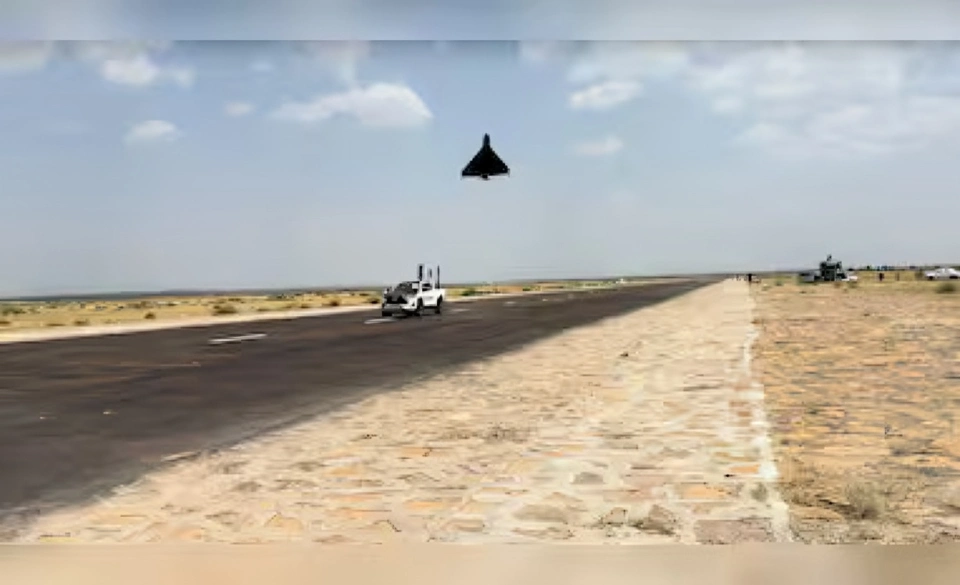
India has successfully tested KAL, an indigenous long-range attack drone designed to strike targets up to 1,000 kilometers away. Times of India reported that Noida-based IG Defence launched the drone from a vehicle-mounted platform at Pokhran Field Firing Range in Rajasthan, validating its airframe, propulsion, avionics and navigation systems. The test marks India's push to build domestic strike-drone capabilities comparable to systems like Iran's Shahed that have seen heavy use in recent conflicts.
KAL is engineered for seven to eight hours of flight time, a 50-kilogram payload capacity, and operations at altitudes up to 5,000 meters, NewsBytes reported. The drone weighs 200 kilograms at maximum takeoff and cruises at 160 to 200 km/h. Defence.in noted that KAL is designed as a one-way attack system for infrastructure, radar installations and air-defense targets, subject to authorization.
Vehicle Launch and Operational Flexibility
IG Defence designed KAL around four core priorities: long-range flight, autonomous operation, payload capacity and scalable domestic production. The vehicle-mounted launch configuration is a critical feature. According to the company, this setup allows KAL systems to operate from dispersed road-mobile positions rather than fixed launch sites. This flexibility could enhance survivability in contested environments by reducing reliance on permanent infrastructure.
Advanced Navigation for Autonomous Missions
KAL's autonomous navigation system combines multi-band satellite navigation with an inertial navigation system, allowing it to fly independently to distant targets. SSB Crack reported that the Pokhran trial validated this integrated approach under field conditions. The drone can operate for seven to eight hours, giving it sufficient endurance to reach targets across a 1,000-kilometer range without pilot intervention or real-time ground control.
Part of Broader India Defense Drone Push
The KAL trial follows India's first military Dronathon at Pokhran, held September 14 to 16. More than 20 start-ups, manufacturers, small businesses and academic teams demonstrated unmanned and counter-drone technologies in desert conditions. Defence.in noted that KAL integrates with IG Defence's GRID Battle Management System, an AI-powered network for coordinating unmanned weapons and processing operational data. Together, these systems reflect India's effort to develop scalable, cost-effective strike capabilities.
Shahed-Style Capability at Domestic Scale
KAL mirrors the design approach of Iran's Shahed and Geran loitering munitions, which have proven effective and relatively inexpensive in recent conflicts. India's development of a comparable system domestically offers strategic advantages: reduced dependence on imports, faster iteration cycles, and integration with Indian military networks. Times of India highlighted that KAL's 50-kilogram high-explosive warhead makes it capable of damaging critical military infrastructure. The successful Pokhran test signals that India is closing the gap in this technology category.
Sentiment
Mostly PositiveNEGATIVENEUTRALPOSITIVE
Publishers
12
Articles
6
Reach
18
A
AnonymousAuthor