Ancient Paris Origins Found
Ancient Stone Wall Discovered Beneath Paris Hotel May Reveal City's True Origins
Anonymous
Key Points
1
Lutetia is first mentioned in Book Seven of Julius Caesar’s *Commentaries on the Gallic War*, which describes the settlement as being on an island in the Seine but does not specify its exact location—one reason the Île de la Cité and Nanterre theories have persisted.
2
Culture Minister Catherine Pégard said, “We may be looking at one of the most important remains ever discovered for understanding Gallic Lutetia,” while stressing that researchers still need to verify the wall’s function and chronology.
3
The discovery was made during archaeological excavations beneath the Hôtel-Dieu, rather than as an isolated surface find, and the site was subsequently visited by Paris Mayor Emmanuel Grégoire and Culture Minister Catherine Pégard.
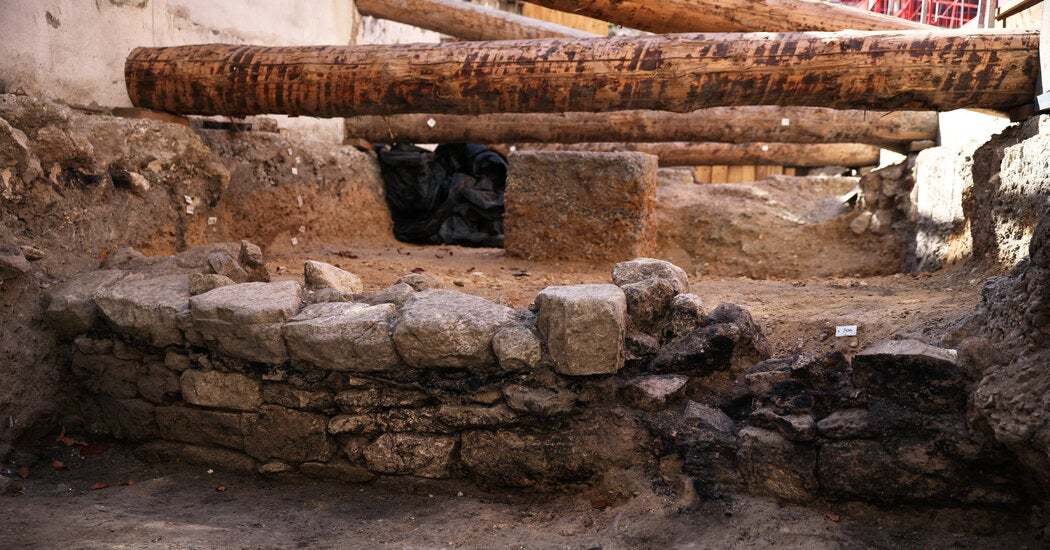
Archaeologists have discovered a roughly 20-meter stone and wood wall beneath the Hôtel-Dieu hospital on Paris's Île de la Cité, near Notre-Dame Cathedral, according to France24. The find may settle a centuries-old debate about where Paris truly began. Traces of fire and radiocarbon dating place the wall around 200–10 B.C., potentially matching Julius Caesar's account of Gauls burning Lutetia before a Roman battle in 52 B.C.
France's Culture Minister Catherine Pégard called it 'one of the most important remains ever discovered for understanding Gallic Lutetia,' France24 reported. Yet researchers still must confirm the wall's exact purpose and timeline. The discovery reignites the long-standing argument: Did Paris originate on the island, or in Nanterre, west of the city?
The Wall That Could End a Two-Century Debate
Lutetia appears in Julius Caesar's *Commentaries on the Gallic War*, described as an island settlement in the Seine. Yet Caesar never pinpointed its exact location, according to France24. This vagueness fueled two competing theories: the Île de la Cité versus Nanterre. The newly discovered wall, buried 2,000 years beneath a hospital, may finally answer the question.
The wall measures 65 feet long and is built from stone and wood. Charred material found on it was radiocarbon-dated to roughly 200–10 B.C. This timing aligns with Caesar's account that Gauls deliberately burned Lutetia before Roman forces arrived in 52 B.C., France24 reported.
Defensive Rampart Theory Gains Ground
Researchers believe the wall was part of Lutetia's defensive ramparts, designed to protect the settlement from invaders. The burn marks suggest it may have been deliberately torched during conflict. Yahoo News Singapore noted the find strengthens the case that Paris's original heart lay on the Île de la Cité rather than Nanterre.
Yet uncertainties remain. Archaeologists must still establish whether the wall was defensive, part of a structure, or something else entirely. Culture Minister Pégard stressed the need for further study before drawing final conclusions about Lutetia's true location.
How the Discovery Unfolded
The wall emerged during systematic excavations beneath the Hôtel-Dieu hospital on the Île de la Cité, not as a chance surface find. Once unearthed, the discovery attracted immediate attention. Paris Mayor Emmanuel Grégoire and Culture Minister Catherine Pégard visited the site, underscoring its significance for the city's archaeological heritage.
Sentiment
Mostly NegativeNEGATIVENEUTRALPOSITIVE
Publishers
27
Articles
57
Reach
84
Topics
A
AnonymousAuthor


