Rare Cosmic Gravitational Lensing
James Webb Space Telescope Confirms Multiple Gravitational Lenses in Single Cluster
Anonymous
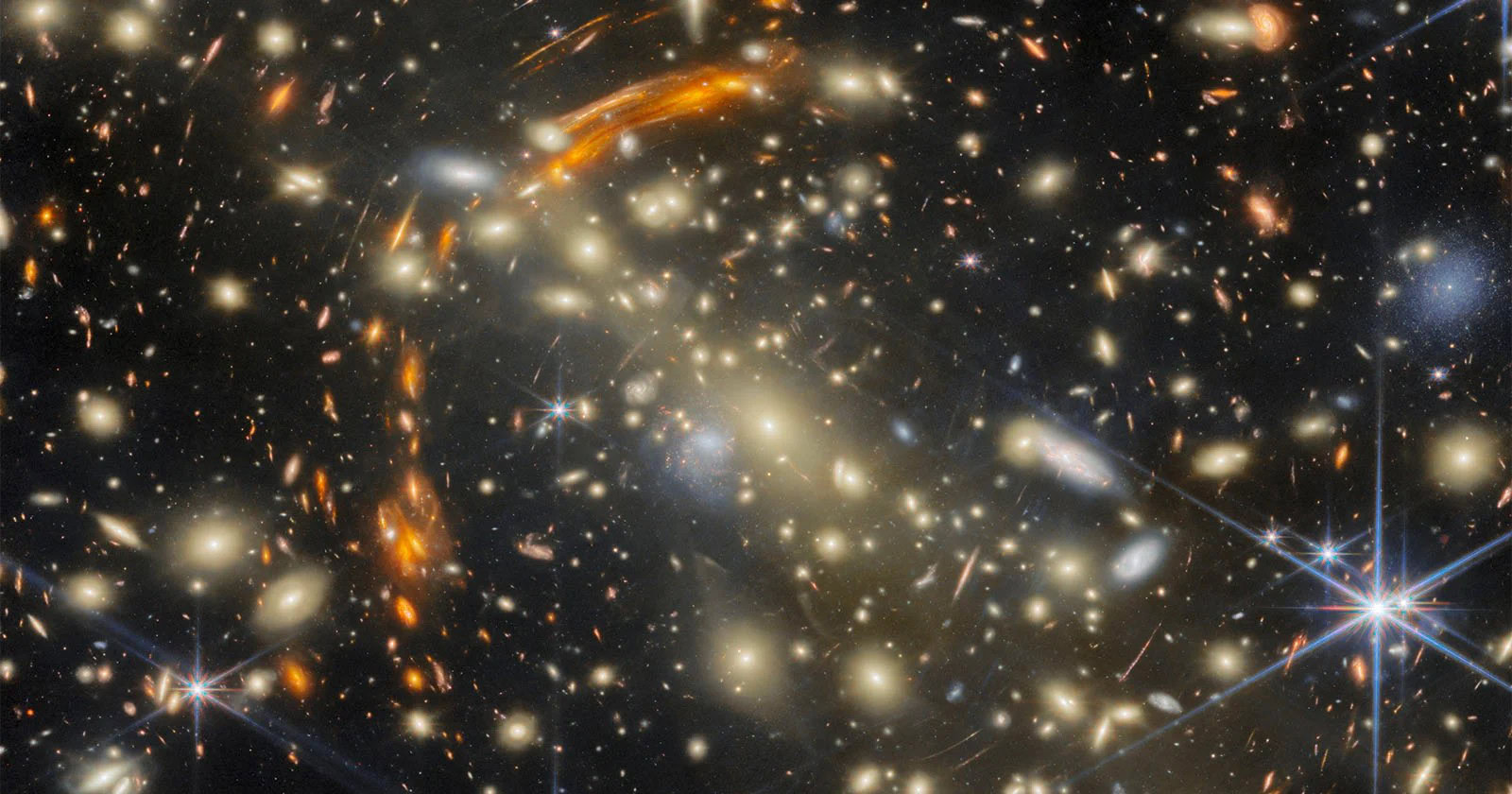
The James Webb Space Telescope’s latest view of galaxy cluster MACS J0454.1-0300 shows how its immense gravity bends and magnifies light from more distant galaxies, making them appear as stretched arcs or multiple images. The cluster is about five billion light-years away, and its light shows it as it was when the universe was roughly eight billion years old. Webb captured two cases in which a background galaxy appears in four or more images—a rare alignment seen in only 10 to 20 percent of galaxy clusters and, researchers say, the first time multiple examples have been confirmed in one cluster. The lensed objects include a merging galaxy group with intense star formation and a galaxy that existed only 800 million years after the Big Bang, offering researchers a closer look at early cosmic evolution.
Key Points
1
Webb’s observations reveal compact, bright structures about five light-years across in the lensed regions; some are magnified by a factor of 300 or more, giving astronomers a detailed view of distant star-forming regions.
2
The cluster’s lensing power comes from its enormous mass, including dark matter, which makes up most of the cluster’s weight and helps bend background light into multiple images and arcs.
3
The article explains gravitational lensing as a consequence of Einstein’s general theory of relativity: massive objects curve spacetime and alter the path of light from objects behind them.
4
Webb’s 6.5-meter primary mirror and ability to observe at redder wavelengths help astronomers use lensing to investigate faint, distant objects that would otherwise be difficult to see.
Sentiment
Mostly NegativeNEGATIVENEUTRALPOSITIVE
Publishers
8
Articles
78
Reach
86
Topics
A
AnonymousAuthor


