Possible First Adult T. Rex Trackway Found
Possible First Adult T. Rex Trackway Found
Anonymous
Key Points
1
The trackway was found on federal land administered by the U.S. Forest Service near Marmarth, North Dakota.
2
Study co-author Tyler Lyson initially doubted the discovery after seeing only one impression, noting that rocks can erode into dinosaur-like shapes: “Initially I wasn't convinced because it was only one print.”
3
Before this discovery, paleontologists had identified only two adult T. rex footprints worldwide—one in New Mexico and one in Montana—making the connected North Dakota sequence especially significant.
4
Hups said the feature initially looked unusual rather than clearly fossilized: “I saw something sticking up out of the ground, and it looked really peculiar, like nothing I’d ever seen before.”
5
The Hell Creek Formation was once a forested floodplain containing streams and swamps; its soft sediments helped preserve dinosaur bones and likely contributed to the preservation of the tracks.
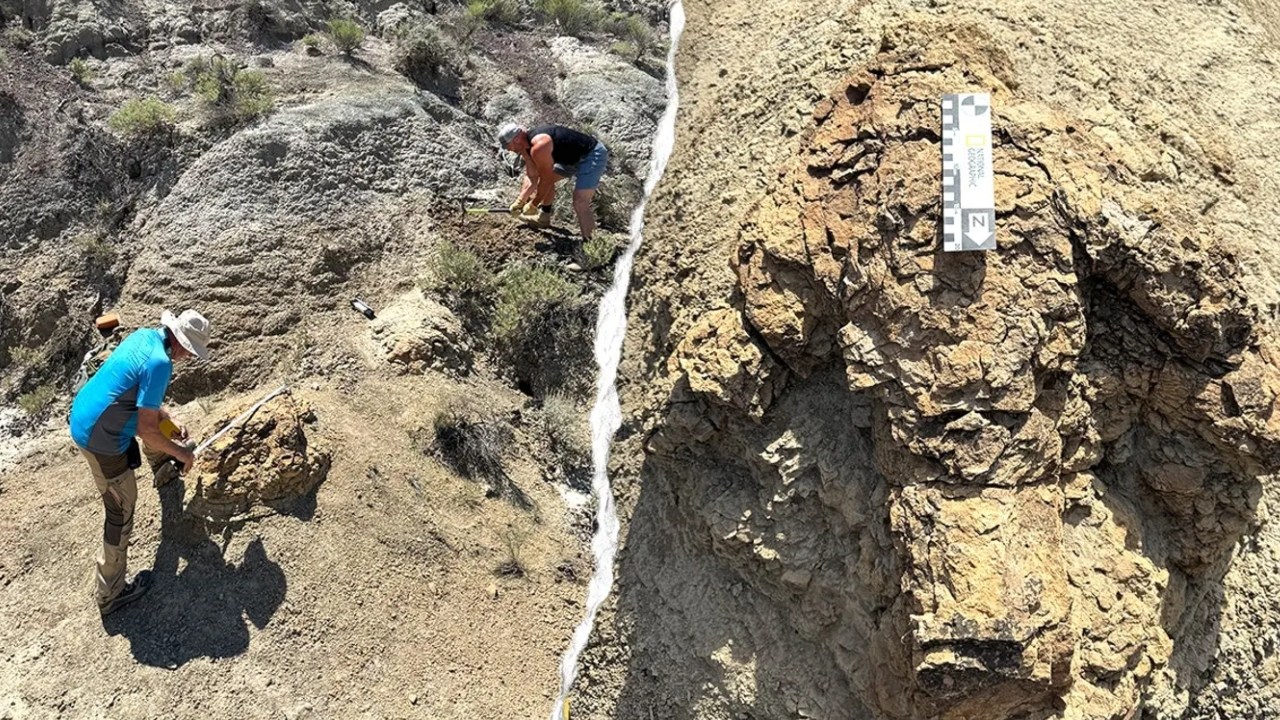
Researchers have identified what may be the first known trackway left by an adult Tyrannosaurus rex, a discovery that could transform how scientists understand the massive predator's movement. The four giant footprints—each roughly 3 feet long—were found on federal land near Marmarth in North Dakota's Hell Creek Formation and date to approximately 66.5 million years ago, according to ABC News.
High school teacher and fossil hunter Kent Hups discovered the impressions while volunteering at a dig in 2025. Scientists from the Denver Museum of Nature & Science and Liverpool John Moores University studied the 23-foot trackway, using high-resolution 3D scans to show the dinosaur walked at roughly 3.5 to 4.5 mph with strides of about 13 feet, as reported by EarthSky.
The Accidental Discovery That Changed Paleontology
Hups spotted something unusual jutting from the ground during a routine fossil dig. "I saw something sticking up out of the ground, and it looked really peculiar, like nothing I'd ever seen before," he recalled, according to News Bytes. The teacher's careful observation led him to report the finding, which scientists then verified as genuine T. rex footprints.
When paleontologist Tyler Lyson first reviewed the discovery, he was skeptical. "Initially I wasn't convinced because it was only one print," Lyson noted. Rocks can erode into dinosaur-like shapes, making singular impressions unreliable. But the discovery of three additional prints in a connected sequence convinced him and the research team.
Why This Trackway Matters More Than Past Footprints
Before this find, paleontologists had identified only two adult T. rex footprints worldwide—one in New Mexico and one in Montana. Most known T. rex tracks came from juvenile dinosaurs. The connected North Dakota sequence of four prints is exceptional because it shows the dinosaur's actual walking pattern, not just isolated steps.
The prints reveal crucial details about adult T. rex movement. Researchers measured strides of roughly 13 feet and calculated the animal's speed at 3.5 to 4.5 mph. The narrow, well-defined toes and massive 3-foot length of each print left no doubt about the creature's identity and size, EarthSky reported.
Ancient Landscape Preserved the Predator's Path
The Hell Creek Formation was once a lush forested floodplain dotted with streams and swamps approximately 66.5 million years ago. Soft sediments in this environment readily preserved dinosaur bones and, crucially, the deep impressions left by walking feet. The sandy rock captured fine details of toe shape and texture.
The trackway was discovered on U.S. Forest Service land near Marmarth in southwestern North Dakota. Scientists from two institutions published their findings in the Journal of Vertebrate Paleontology in September 2026. The research offers rare, direct evidence of how the apex predator moved through its ancient ecosystem.
Sentiment
Mostly NegativeNEGATIVENEUTRALPOSITIVE
Publishers
19
Articles
29
Reach
48
A
AnonymousAuthor


